
There is little doubt that Manchester United’s long and frustrating search for a world-class football manager has defined the post–Sir Alex Ferguson era.
Since Ferguson’s retirement, the club has cycled through a series of high-profile appointments in an attempt to restore the dominance that once made United the most feared and successful team in England and Europe.
Replacing Sir Alex Ferguson was always going to be one of the hardest jobs in world football. The legendary Scotsman delivered 13 Premier League titles during his historic reign at Old Trafford, setting a standard that few managers in football history could ever hope to match. What followed has been a period of uncertainty, experimentation, and unfulfilled promise.
In their relentless pursuit of the “right” man, Manchester United have cycled through a wide range of managerial profiles, often placing their trust in reputation rather than long-term vision.
The club experimented with sharply contrasting footballing philosophies — from the pragmatic, defensively structured approach associated with managers such as José Mourinho, to the high-intensity gegenpressing system introduced by Ralf Rangnick, who oversaw a brief but significant transitional period at the club.
Ultimately, these constant stylistic shifts prevented continuity, leaving Manchester United without a clear, long-term footballing identity — something that had been so clearly defined under Sir Alex Ferguson.
During this same period, their biggest rivals — Manchester City and Liverpool — surged ahead, enjoying sustained success under the clear tactical visions of Pep Guardiola and Jürgen Klopp over the last five years.
The closest United came to reclaiming the Premier League title was under Ole Gunnar Solskjær, when the club finished second.
Yet even Solskjær himself admitted that the achievement fell short of Manchester United’s standards, publicly apologising for not delivering more — a reflection of the immense pressure and expectations attached to the role.
Things only deteriorated further under Erik ten Hag and Ruben Amorim, the two most recent managers to be sacked at Old Trafford. So bleak did the situation become that many fans would now gladly accept that once-criticised second-place finish without hesitation.
Performances continued to decline, confidence within the squad eroded, and frustration among supporters reached new heights — despite Manchester United’s heavy investment in high-profile signings, including Antony, Jadon Sancho, and Aaron Wan-Bissaka, among others.
However, the mood has shifted dramatically with Michael Carrick appointed as interim head coach. Manchester United are once again entertaining to watch, showing structure, clarity, and confidence on the pitch.
The team currently sits fourth in the league, having recorded impressive and convincing victories against major opponents such as Manchester City and Arsenal. More importantly, those wins were achieved with control and authority, displaying the hallmarks of a well-coached side.
In this article, we examine nine key reasons why Michael Carrick deserves to be confirmed as Manchester United’s permanent manager. His impact has gone beyond short-term stabilization, and his work has shown that he is more than an interim solution.
This is why the former United midfielder should now be seriously considered as the long-term head coach of Manchester United.
1. Results on the Pitch: Winning and Entertaining Football
Since being appointed interim manager, Michael Carrick has delivered immediate results in the Premier League, winning three out of three league matches while restoring excitement and belief at Old Trafford. Those victories included convincing wins over Manchester City and Arsenal at the Emirates Stadium, two sides widely regarded as Premier League title contenders, as well as a dramatic 3–2 late winner against Fulham at Old Trafford.
Beyond the results, the tactical transformation has been striking. Carrick’s setup has been highly organised, compact, and disciplined, with Manchester United rarely conceding clear chances or allowing Manchester City and Arsenal to dominate dangerous areas. The team has defended with structure and control, limiting space and denying momentum to elite opposition.
In possession, United have looked confident, fluid, and purposeful. Every pass, movement, and positional rotation appears calculated and intentional, with the side carrying genuine threat every time they move forward. The attacking play has been direct yet intelligent, blending flair with efficiency.
That shift was summed up perfectly by Lisandro Martínez, who explained Carrick’s instant impact in simple terms: playing with the ball and playing with confidence. At the highest level, progressive football is non-negotiable — it is about building a fast, lethal, and effective attack when in possession, something United have rediscovered almost overnight.
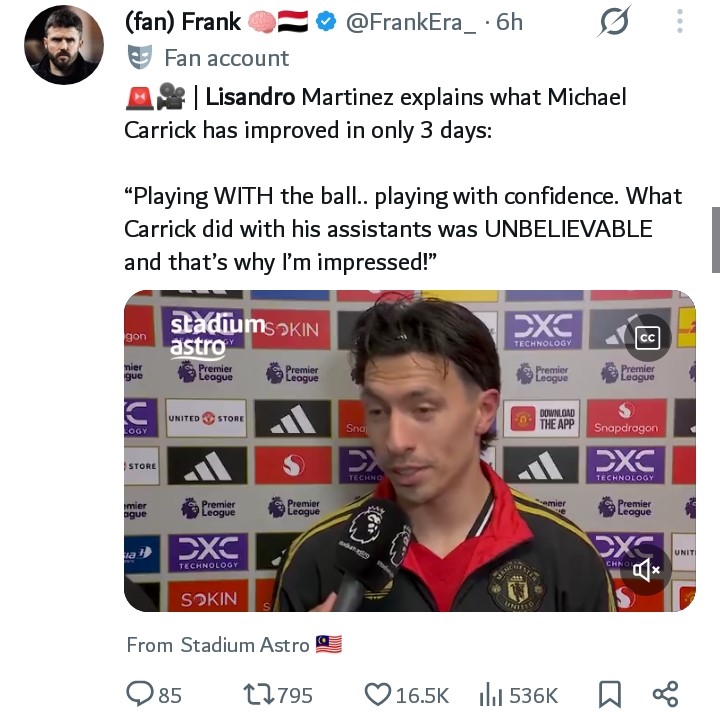
As one supporter aptly observed, Ruben Amorim spent months insisting this squad was not good enough, delivering lifeless and disjointed performances in the process — only for Michael Carrick to arrive and expose that narrative immediately.
Under Carrick, Manchester United defended compactly, pressed with aggression and intensity, and physically imposed themselves on the so-called favourites. As underdogs, United won 2–0 with authority and without fuss, completely controlling the contest.
This was never a quality issue. It was never about the players. It was a coaching failure. Carrick needed one game to demonstrate what Amorim could not achieve in months — and in doing so, Manchester City were comprehensively outplayed.
2. Big-Money Signings Delivering Goals and Confidence
Before Michael Carrick’s appointment as interim manager of Manchester United, Bryan Mbeumo stood out as the only new big-money signing who had truly hit the ground running. That came as little surprise, given the consistency and end product he showed at Brentford prior to his move to Old Trafford ahead of the 2025–26 Premier League season.
Matheus Cunha had been receiving minutes and producing respectable performances, but under Carrick, his impact has accelerated dramatically. The Brazilian has now scored in two of his three matches under the interim boss — including a stunning strike against Arsenal, beating what many consider the best goalkeeper in the Premier League, and another crucial goal against Fulham.
Beyond the numbers, Cunha looks liberated and expressive, even showcasing his trademark flair on the pitch — moments that have caught Amad Diallo’s attention and sparked debate among supporters over whether an Amad–Cunha partnership could be the next blossoming bromance at Old Trafford. This comes just as fans were beginning to enjoy the strong on- and off-pitch chemistry between Amad and Mbeumo, a partnership that may have been vital in helping Mbeumo settle into life at Manchester United.
There are encouraging signs elsewhere too. Benjamin Šeško, introduced from the bench against Fulham, appeared energised and confident, even if it was only one appearance. The striker looked eager to contribute, making intelligent runs into the penalty area, posing a consistent aerial threat thanks to his outstanding physical presence, and displaying the body language of a player enjoying his football.
Manchester United supporters — and football fans more broadly — will be eager to see Šeško operating at his best, competing season after season with elite attacking talents such as Erling Haaland, Mohamed Salah, and Mbeumo at the highest level.
Looking ahead, Carrick’s next challenge will be managing minutes and egos, ensuring players like Šeško, Mbeumo, and Cunha remain motivated even when not starting. So far, however, he has succeeded in keeping his attacking options inspired, with substitutes stepping onto the pitch ready to change games in Manchester United’s favour.
3. Deep Understanding of the Club and Elite Midfield Pedigree
There is a widely held belief in football that great players do not always become great managers — but, as with most rules, there are notable exceptions. Michael Carrick may well be one of them.
Carrick enjoyed a long, distinguished Premier League career as one of the most intelligent and reliable defensive midfielders of his generation. At Manchester United, he played under the greatest manager in the club’s history, Sir Alex Ferguson, while sharing the dressing room with some of the biggest personalities and elite talents in world football, including Wayne Rooney and Cristiano Ronaldo, alongside numerous other top-level performers.
That experience matters. Carrick understands the standards, pressures, and expectations that come with representing Manchester United, and he knows what it takes to manage big names and strong personalities — a skill that remains critical in today’s modern dressing room.
His quality as a player was also recognised at the very highest level. Pep Guardiola once described Michael Carrick as “one of the best holding midfielders I have ever seen in my life — by far,” a remark made after Guardiola’s side were beaten by Carrick’s Manchester United in a Manchester derby.
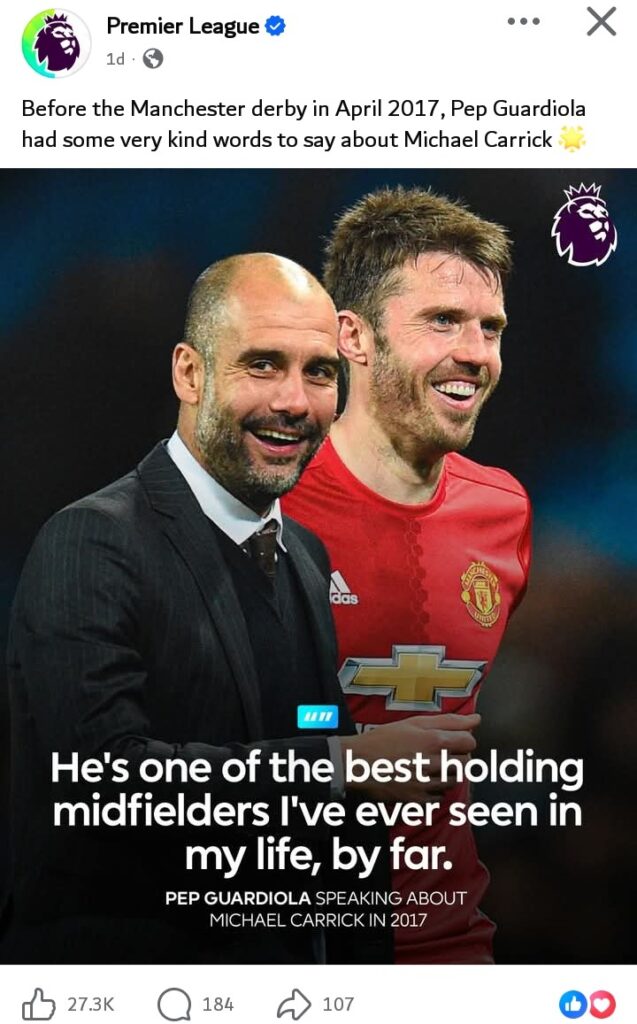
Praise of that magnitude, from one of the greatest tacticians in football history, underlines the football intelligence Carrick brings to management.
4. Ask Cristiano Ronaldo
The last time Cristiano Ronaldo attempted to raise concerns about the direction of Manchester United, following his fallout with then-manager Erik ten Hag, many sections of the fan base later admitted they wished they had listened more carefully. Ronaldo was widely scapegoated during that period, with Ten Hag frequently cited as placing responsibility on him for the club’s poor performances.
The situation ultimately ended with Ronaldo’s acrimonious departure from Old Trafford, a relationship that broke down publicly and painfully. In a subsequent interview, the Portuguese forward appeared to question Ten Hag’s understanding of football, a comment that sparked widespread debate across the football world.
Against that backdrop, fans were quick to pay close attention to what Ronaldo later said about Michael Carrick. Importantly, Carrick had managed several matches while Ronaldo was still a Manchester United player, meaning Ronaldo had first-hand exposure to Carrick’s man-management, tactical organisation, and approach on the touchline.
That context gives weight to Ronaldo’s assessment. Having played under some of the greatest managers in football history, Ronaldo is uniquely qualified to recognise quality when he sees it. Writing on his X (formerly Twitter) account, Ronaldo said:
“Michael Carrick was a class act as a player and he can become a great coach as well. Nothing is impossible for this guy. Personally, I am proud to have played with him by my side as well as with him as our manager on our bench.”
Endorsements of that nature, from a player of Ronaldo’s stature and experience, only reinforce the argument that Michael Carrick possesses the credibility, football intelligence, and leadership qualities required to manage Manchester United at the highest level.
5. He Freed Kobbie Mainoo
Let’s be honest: Ruben Amorim can be forgiven for many decisions, but his handling of Kobbie Mainoo is one issue a large section of the Manchester United fan base now openly questions. Under Michael Carrick, Mainoo has been restored to the starting XI — and, quite simply, freed.
While Mainoo continues to benefit from the presence and experience of the departing Casemiro, his performances under Carrick have revealed a midfielder playing with confidence, authority, and freedom. Against elite opposition — Manchester City and Arsenal — the 20-year-old went toe-to-toe with some of the very best midfielders in world football, including Rodri, Bernardo Silva, Declan Rice, and Martín Zubimendi. Remarkably, he made it look routine.
That perspective matters. Mainoo is just 20 years old, a homegrown academy graduate, and widely viewed as a generational midfield talent. Yet on the biggest stages, he played with the composure of a seasoned professional.
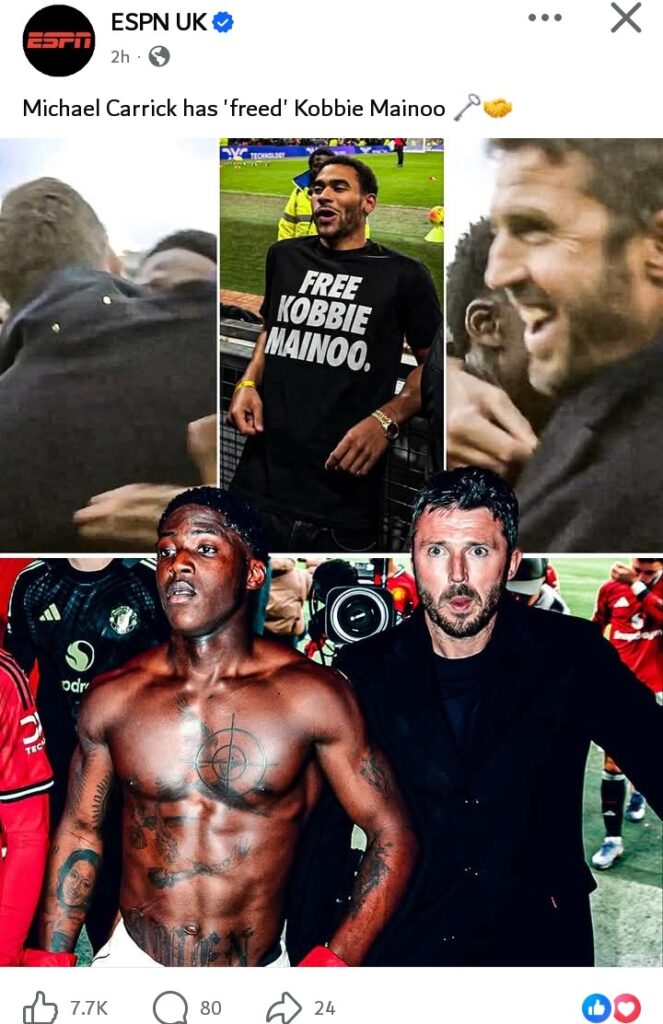
We previously highlighted why Mainoo emerged as the biggest beneficiary of Amorim’s dismissal at Manchester United, and the evidence is now even clearer: Kobbie Mainoo has also become the biggest winner of Michael Carrick’s appointment as interim manager.
Carrick’s belief in Mainoo is no coincidence. He knows the player well, having worked with him during his teenage years as he rose through the academy ranks. And as a former elite Premier League midfielder, Carrick understands quality when he sees it.
Speaking recently about Mainoo, Carrick said:
“This club needs young players coming through. They are the foundation of the club. You’ve seen last week what Mainoo can bring. I started working with Kobbie when he was 13 or 14 when I was doing my coaching badges.”
Under Carrick, Kobbie Mainoo is not being restricted — he is being trusted, and Manchester United are already reaping the rewards.
6. He Returned Bruno Fernandes to His Best Position
It is difficult to avoid referencing Ruben Amorim, given he was the most recent manager to be dismissed at Manchester United — and Michael Carrick’s early impact has already highlighted several of the tactical mistakes made before him.
One of the most puzzling claims under Amorim was the suggestion that Kobbie Mainoo and Bruno Fernandes were competing for the same position. This was despite clear evidence, over multiple matches and systems, that the two could operate together in the same midfield, with Bruno functioning as a natural No.10 while Mainoo provided balance and progression from deeper areas. When deployed correctly, the pair complemented each other and consistently delivered strong performances.
Carrick has moved quickly to correct that imbalance, restoring Bruno Fernandes to his advanced midfield role, closer to the opposition penalty area. The results have been immediate. Bruno has rediscovered his goal contributions, once again influencing games through assists, shots, and decisive final-third actions.
For many supporters, this shift has been long overdue. Bruno’s greatest strengths lie in creativity, chance creation, and risk-taking, qualities that are maximised when he operates near the opponent’s goal. His chance creation numbers remain among the highest in the Premier League, and under Carrick, he is finally being positioned where his impact is most dangerous.
7. The Fulham Comeback Revealed His Personality
Some may dismiss this as a minor detail, but in reality, a manager’s personality and touchline demeanour can be decisive — not only for supporters, but for players executing instructions under pressure. In elite football, body language matters, especially in moments of crisis.
When chaos strikes, teams need a calm, reassuring presence on the touchline, not a constantly agitated figure pacing nervously, waving arms, and projecting panic. Composure from the manager often translates into composure on the pitch.
That quality was on full display during Manchester United’s dramatic comeback against Fulham at Old Trafford. When United allowed a 2–0 lead to slip, conceding in the 86th and 92nd minutes to make it 2–2, Michael Carrick remained visibly composed on the sidelines.
There was no panic, no loss of structure. Instead, United stayed focused — and were rewarded when substitute Benjamin Šeško scored the late winner in the 90+4th minute. Even then, Carrick showed clarity of thought, making a pragmatic substitution in the 90+6th minute, introducing Leny Yoro for striker Bryan Mbeumo to see the game out.
In those critical minutes, Carrick’s calm authority, decision-making, and game management stood out. It was a clear indication of a manager comfortable under pressure — a trait Manchester United have often lacked in recent seasons.
8. Unfazed by the Game’s Biggest Managerial Names
This point is straightforward and difficult to ignore. Across two separate spells as Manchester United head coach, Michael Carrick has overseen just four matches — yet his record against elite managerial opposition is remarkable.
In those limited outings, Carrick has beaten Pep Guardiola, Unai Emery, and Mikel Arteta, while also earning a draw against Thomas Tuchel — a group that represents some of the finest tactical minds in modern football.
The results speak for themselves. On 23 November 2021, Carrick guided Manchester United to a 2–0 victory over Unai Emery’s Villarreal. Just five days later, on 28 November 2021, United held Thomas Tuchel’s Chelsea to a 1–1 draw.
More recently, on 17 January, Carrick’s side produced a commanding 2–0 win over Pep Guardiola’s Manchester City. That was followed by two dramatic victories over Mikel Arteta’s Arsenal — a 3–2 win at Old Trafford on 2 December 2021, and another 3–2 triumph at the Emirates Stadium on 25 January.
Beating top teams is one thing; consistently outmanoeuvring elite managers is another. Carrick has shown no fear, no inferiority complex, and no tactical timidity when facing the biggest names in the game — a crucial trait for any manager tasked with leading Manchester United back to the top.
9. He Wants the Return of Marcus Rashford
According to reports, Michael Carrick wants Marcus Rashford back at Manchester United — and for many supporters, that matters deeply. Rashford is a player fans care about. Yes, there have been moments of unprofessionalism, such as lateness for training or matches, and those issues cannot be ignored. But they do not erase the fact that Rashford is an immensely talented footballer.
His quality has never been in doubt. We have seen Rashford deliver on the biggest stages for Manchester United, capable of changing matches with pace, directness, and goals. Alongside Kobbie Mainoo, he represents the best of the club’s academy pipeline in the modern era — a homegrown talent who rose without a transfer fee and carried the club through difficult periods.
Rashford is also human, and like many players, he was affected by Manchester United’s prolonged managerial instability following the departure of Louis van Gaal. The constant changes in leadership disrupted form and confidence across the squad — impacting not only academy graduates, but also high-profile, big-money signings. Rashford was not an isolated case.
It is also important to address how his situation was handled. The suggestion that a 65-year-old goalkeeping coach had a better chance of making the matchday squad than Rashford, before his eventual exclusion, felt excessive and unfair to many observers. There is no footballing reality in which that claim holds weight.
That perspective has since been reinforced in Spain, where Barcelona head coach Hansi Flick has done excellent work with Rashford. Currently on loan, Rashford looks re-energised, confident, and happy, once again expressing himself on the pitch — a clear indication that the ability never disappeared.
If Michael Carrick truly wants Marcus Rashford back, then it signals an understanding of Manchester United’s identity, academy culture, and long-term vision. And for many fans, that alone strengthens the case: if Carrick wants Rashford back, then Carrick deserves backing too.
What the Experts and Legends Are Saying About Michael Carrick
The praise for Michael Carrick has been overwhelming, coming from a wide spectrum of football voices, from former teammates to pundits and rival managers.
Peter Schmeichel, reflecting on Manchester United’s performance in the Manchester City derby on 17 January 2026, said:
“As a Manchester United fan, for the first time in a long time, it was an absolute joy to watch them play. Thank you, Carrick.”
Gary Neville was equally impressed, remarking:
“It makes you think, what have they been doing for the last 18 months?”
Neville was referring to the period under Ruben Amorim, adding that Carrick had completely blown him away with his tactical approach and man-management.
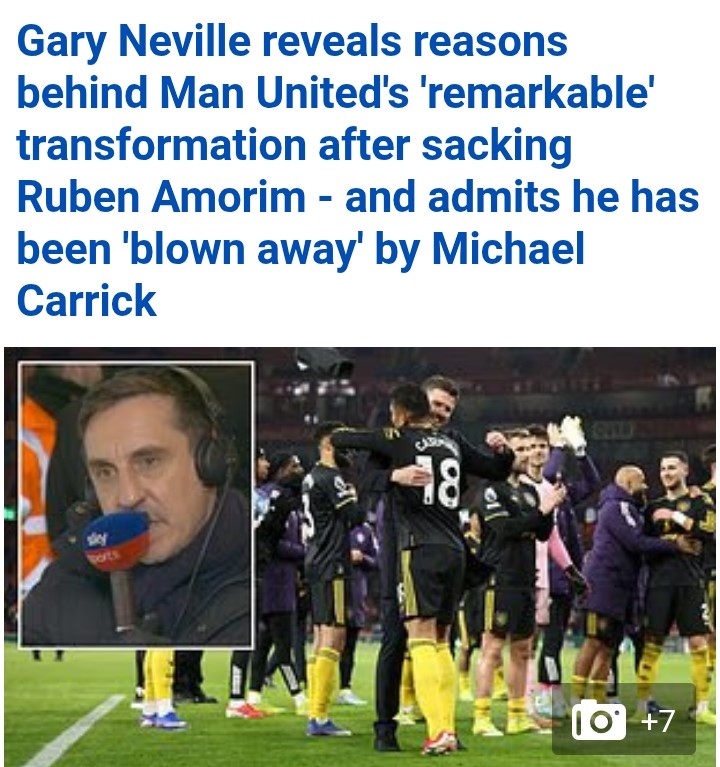
Even rival voices took notice. After Manchester United’s win over Arsenal, former Arsenal manager Arsène Wenger praised Carrick, stating:
“I must congratulate Michael Carrick, he has created something.”
Daniel Sturridge, now a level-headed pundit, left a simple yet emphatic verdict:
“Give him what he wants. Sign the contract.”
Among former Manchester United coaches, Rene Meulensteen has been an early and vocal supporter of Carrick taking the permanent role. He explained:
“Michael Carrick might be the obvious option if Ruben Amorim is to go. I think under Carrick you would see a fantastic Manchester United.”
Meulensteen’s prediction appears to be coming true.
The real question now is whether Manchester United’s owners will seize the opportunity. Comparisons have already been drawn with Arsenal’s gamble on Mikel Arteta — another former midfielder with limited managerial experience.
At the Emirates, Arteta has proven the decision can pay off. Could Manchester United take the same bold step with Carrick and trust a club legend to restore glory at Old Trafford?
Conclusion: Why Michael Carrick Deserves the Manchester United Job Permanently
After years of instability, managerial experiments, and unfulfilled promise at Manchester United, Michael Carrick has emerged as a beacon of clarity, intelligence, and leadership. Across just a handful of games, he has demonstrated an ability to win convincingly against top-tier opposition, unlock the potential of big-money signings, restore Bruno Fernandes to his natural position, and give young talents like Kobbie Mainoo the freedom to shine.
Carrick’s tactical nous, forged over a long and decorated career under Sir Alex Ferguson and alongside world-class players such as Cristiano Ronaldo, has translated seamlessly into management. His composure on the touchline, decisive substitutions, and man-management skills have instantly transformed Manchester United into a side capable of competing with Pep Guardiola, Mikel Arteta, and other elite managers.
Endorsements from football legends and pundits — including Peter Schmeichel, Gary Neville, Arsène Wenger, Daniel Sturridge, and Rene Meulensteen — underscore what fans have witnessed on the pitch: Carrick combines football intelligence, leadership, and respect from players, all essential qualities for a Manchester United manager.
Furthermore, his reported desire to bring Marcus Rashford back and nurture academy talents shows a long-term vision aligned with the club’s identity, something previous managers have struggled to achieve. In short, Carrick has already corrected mistakes of his predecessors, demonstrated results, and shown the personality and tactical skill required to lead Manchester United back to glory.
The evidence is overwhelming: it is time for the club’s owners to appoint Michael Carrick as Manchester United’s permanent head coach.
Leave a Reply