
It was more than a defeat for Manchester United.
Hull City beat Manchester United 2-0 on Sunday by exposing the Red Devils’ weaknesses in physical duels, aerial battles, defensive transitions and attacking efficiency.
The newly promoted side did much more than score twice and defend their lead; they repeatedly disrupted Manchester United’s attempts to progress the ball, crowded the penalty area and forced United into increasingly predictable attacks.
The game became a contest of physical strength, aerial ability, defensive organization, speed and, perhaps most importantly, the willingness to compete for every ball.
For Hull City, the reward was historic. It was their first victory over Manchester United in 52 years and their first victory over the Red Devils since the Premier League began.
For Manchester United, it was a historic low: for the first time in the club’s history, they had lost their opening Premier League match in two consecutive seasons.
It was a particularly frustrating afternoon because the problems were not confined to one individual mistake. Captain Bruno Fernandes spoke about individual errors after the game, but the evidence on the pitch suggested a broader and more collective failure.
Manchester United struggled to win the ball back with sufficient intensity. They were repeatedly outmuscled in ground duels, outnumbered around the ball, denied aerially and, most importantly, prevented from finding the spaces required to attack effectively.
Many observers had even considered Manchester United among the favourites for the Premier League title this season.
Hull City, however, showed exactly how a newly promoted side can frustrate a more fancied opponent: defending in a compact shape, closing down passing lanes, tightly marking Manchester United’s most dangerous players, competing aggressively in physical duels and making every attacking possession increasingly uncomfortable.
Hull City’s Compact Low Block Made Manchester United’s Attack Predictable
One of the clearest reasons Hull City beat Manchester United was the speed with which they recovered their defensive shape.
Manchester United were often able to move the ball forward, but once Hull City lost possession, their players dropped back quickly and formed a remarkably compact defensive structure.
A good example came in the 25th minute.
Mazraoui carried the ball forward down the right before finding Mbeumo, who was operating as the right winger.
Ordinarily, this is the kind of situation in which Manchester United would expect their wide player to have an opportunity to deliver a cross into the penalty area.
But Hull City had already recovered.
By the time the ball reached Mbeumo, eight Hull City players were inside the penalty area, while two were already close enough to him to deny him the time and space required to cross.
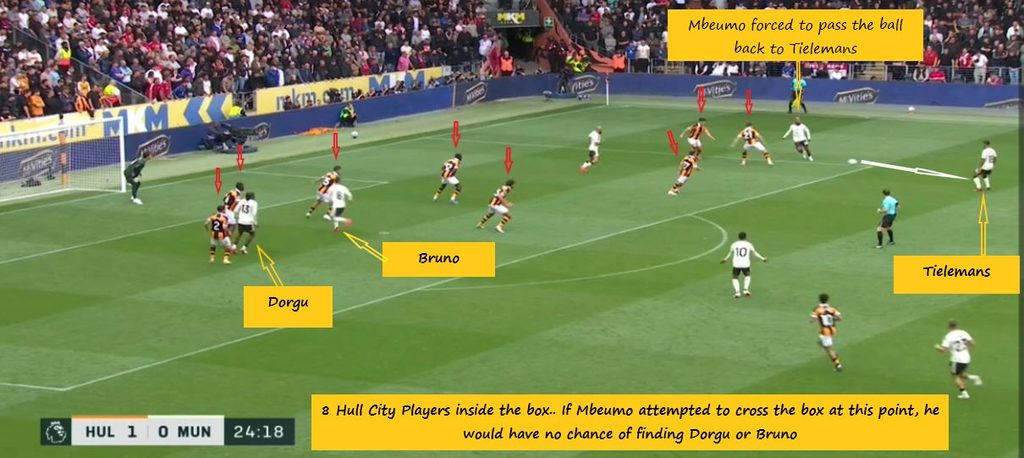
Mbeumo therefore had little choice but to adopt the safer option and recycle possession back to Tielemans.
Tielemans was not presented with a particularly attractive alternative either. He could attempt a long-range shot, but from that angle, distance and with so many Hull City players between him and the goal, such an attempt would have been ambitious.
There are several ways Manchester United supporters could interpret this sequence.
Some may argue that Mazraoui should have progressed the ball more quickly. Others may question whether Manchester United needed a faster right-back. Some may believe Dalot would have handled the situation better.
Another argument would be that Mazraoui should have found Tielemans earlier, allowing the Belgian to use his passing range to release Mbeumo with the kind of defence-splitting pass Manchester United expected him to provide.
But regardless of which individual decision is preferred, the larger tactical point remains the same.
Hull City won the battle of defensive recovery.
Whenever Manchester United attempted to advance the ball, Hull City were able to fall back into position quickly enough to close the available passing lanes.
That forced Manchester United into lateral passes, safer combinations and increasingly predictable attacks.
Even some of the greatest passers in football history would struggle to consistently unlock a defence as tightly organized as this if every defender reaches the correct position on time.
Prime Andrés Iniesta or Andrea Pirlo would still need movement ahead of them, passing lanes and players capable of receiving between the lines.
Hull City repeatedly removed those options.
This is one of the defining challenges of modern football. Breaking down a compact low block requires more than technical quality.
It requires movement, positional rotations, quick ball circulation, individual dribbling, runs behind the defensive line and, sometimes, the physical presence to attack crosses. And these movements must happen quickly if your team is going to beat the opponent.
Hull City denied Manchester United most of those possibilities.
Close Man-Marking Took Away Manchester United’s Time on the Ball
The compact defensive structure was only part of Hull City’s defensive success.
Their players also stayed extremely close to Manchester United’s attacking players.
Another example came shortly afterwards when Dorgu received the ball.
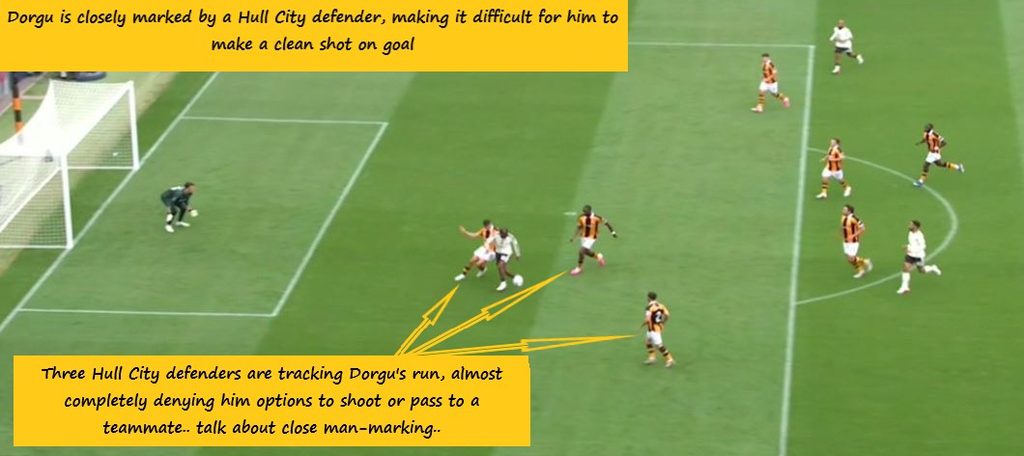
Look at the Hull City players surrounding him. Dorgu was given almost no opportunity to turn, face goal and shoot. Instead, he was immediately surrounded and closely monitored.
This pattern appeared repeatedly.
Manchester United’s attacking and wide players were so tightly marked that Harry Maguire increasingly became one of the few players capable of delivering meaningful balls into the penalty area.
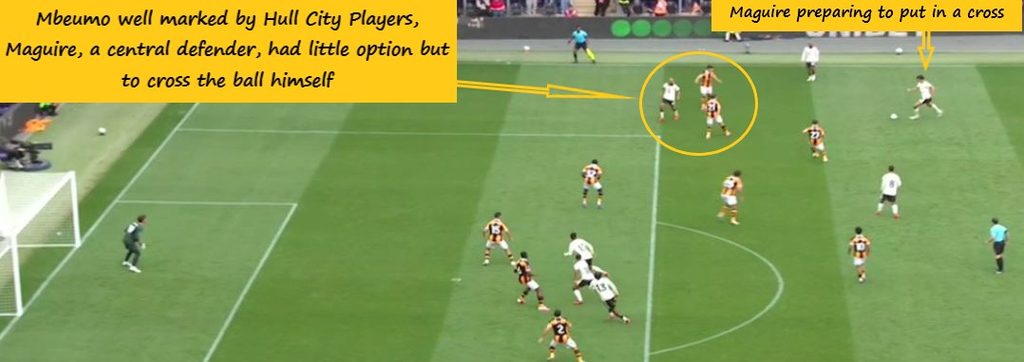
That is significant because it reveals how successfully Hull City had disrupted Manchester United’s normal attacking routes.
By the end of the first half, Manchester United were also described as lacking a “focal point” in attack — someone capable of giving the team’s final-third play a clear reference point and influencing how crosses and passes should be attacked.
That helps explain why Michael Carrick eventually introduced Benjamin Sesko.
Sesko offered something Manchester United were missing: height, physical presence and the ability to operate as a target man.
The problem was that by the time he arrived, Hull City had already established control over the aerial and physical conditions of the match and Manchester United’s resilience was wearing thin.
The 42nd minute provided another illustration.
Mbeumo produced a good run down the right and delivered a cross into the area. But the Hull City penalty area was already crowded with defenders.
The cross was cleared.
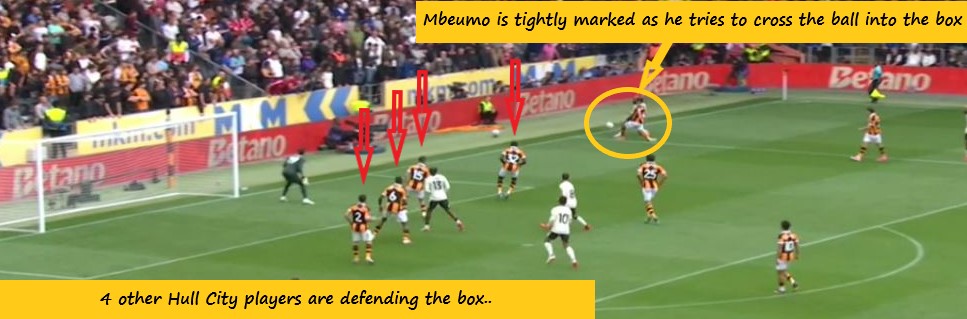
In reality, the attacking move was almost dead before the ball was delivered.
That was the story of Manchester United’s attacking play for much of the game.
Hull City had effectively built a wall around their penalty area.
Interestingly, that almost seemed to have been foreshadowed when Hull City emerged before kick-off accompanied by Bricky, their brick-like mascot.
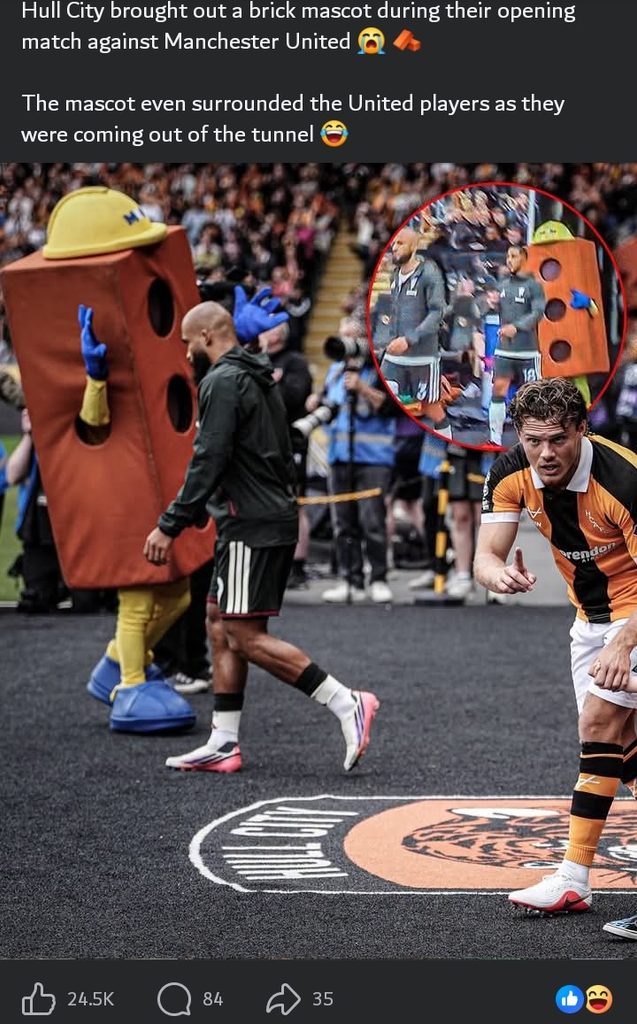
Whatever the intention of the mascot, the image became an appropriate description of what Manchester United encountered: a brick wall of Hull City players whenever they tried to attack.
The 44th minute provided another example.
Bruno Fernandes beat the first defender and attempted to deliver a cross, but four Hull City players stood between him and Dorgu, the intended target.
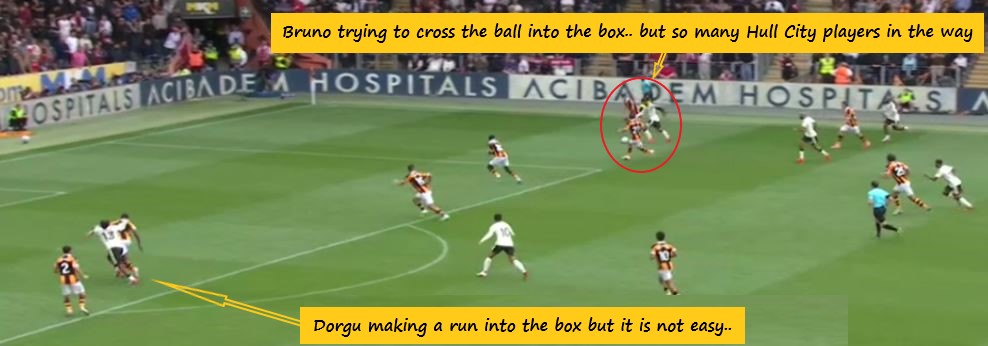
Dorgu was also the only Manchester United player inside the opposition’s 18-yard box. That meant Bruno had beaten the first man but still had virtually no route through which to deliver a dangerous ball.
There was simply too much defensive congestion.
A similar problem appeared around the 46th minute with Mbeumo’s shot.
And in the 55th minute, Rashford made a promising run down the left before finding the overlapping Luke Shaw.
Shaw then attempted to cross.
Again, Hull City had already anticipated the danger.
Four Hull City players stood in the path of the intended delivery into the penalty area. The cross was never likely to reach a Manchester United attacker cleanly.
The best Manchester United could get from the move was a corner.
That sequence tells the story perfectly: Manchester United could reach the final third, but Hull City repeatedly prevented them from converting that territorial advantage into genuine danger.
So effective was Hull City’s defensive organization that Harry Maguire, one of Manchester United’s most physically imposing players and a player positioned further from the packed central areas, began to look like an attacking outlet.
By the end of the game, the commentator observed that Maguire had posed as much danger as a striker.
That was not merely a compliment to Maguire.
It was also an indictment of how effectively Hull City had neutralized Manchester United’s normal attacking options.
Manchester United Kept Losing Possession Under Pressure
Hull City’s defensive organization created another problem for Manchester United: forced and unnecessary turnovers.
When a team is closely marked, receiving the ball becomes more difficult. When there are fewer passing options available, players have less time to make decisions. And when that pressure is repeated for long enough, technically gifted players begin making decisions they would normally avoid.
Manchester United experienced exactly that.
In the 30th minute, Harry Maguire attempted to find a heavily marked Bruno Fernandes.
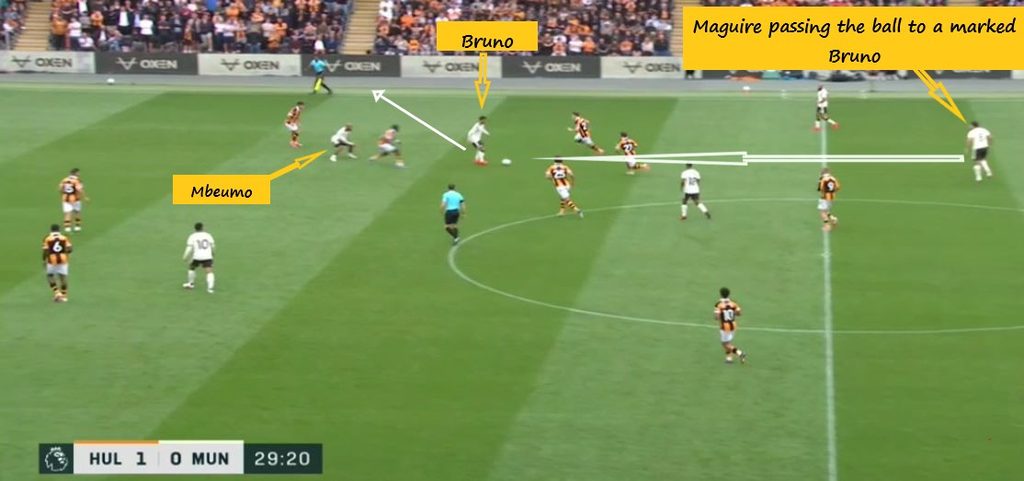
Bruno was already under pressure and had little time to turn or secure possession. He attempted a clever flick towards Mbeumo, but Mbeumo was caught off guard.
Hull City cleared the ball away from danger, sending it back towards Maguire.
It was almost a textbook example of what a compact defence wants to force: a difficult pass into a player who has no room to receive it, followed by a rushed attempt to escape the pressure.
As the commentator correctly observed, it was not the first time a Manchester United player had allowed the ball to run away from him.
Nor was it the last.
In the same minute, Mazraoui found Bruno Fernandes centrally.
But once again, look at what happened around Bruno.
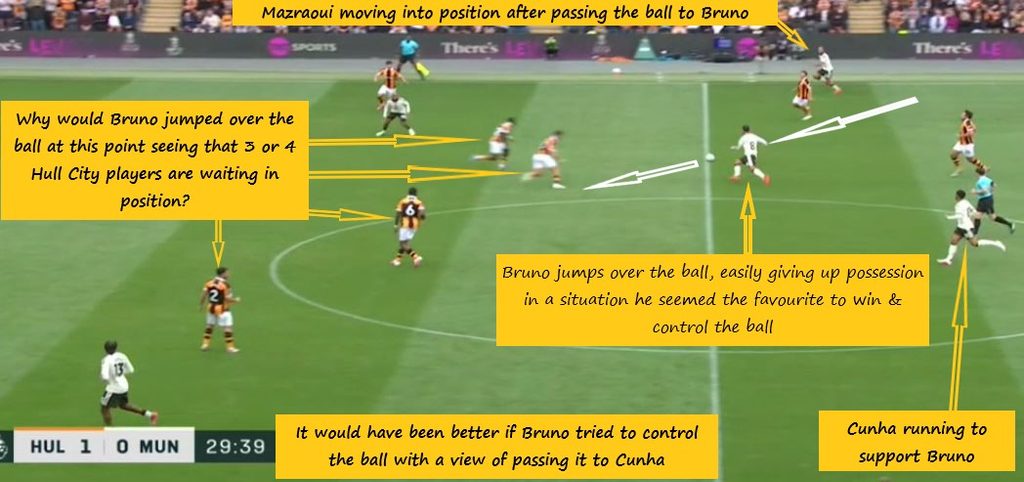
Hull City players immediately charged towards him, closing the space from multiple directions.
Bruno appeared concerned about being tackled and attempted to use a dummy rather than taking full control of the ball. He jumped over it, seemingly hoping that Cunha behind him would understand the intention and collect the pass.
Cunha did not.
Possession was lost again.
It would be difficult to blame Cunha for not reacting quickly enough because the move itself was created by the pressure Bruno was facing.
Perhaps what happened a minute later explains why Bruno was reluctant to take the ball in the first place.
Heaven played another pass towards Bruno, who this time attempted to hold onto possession.
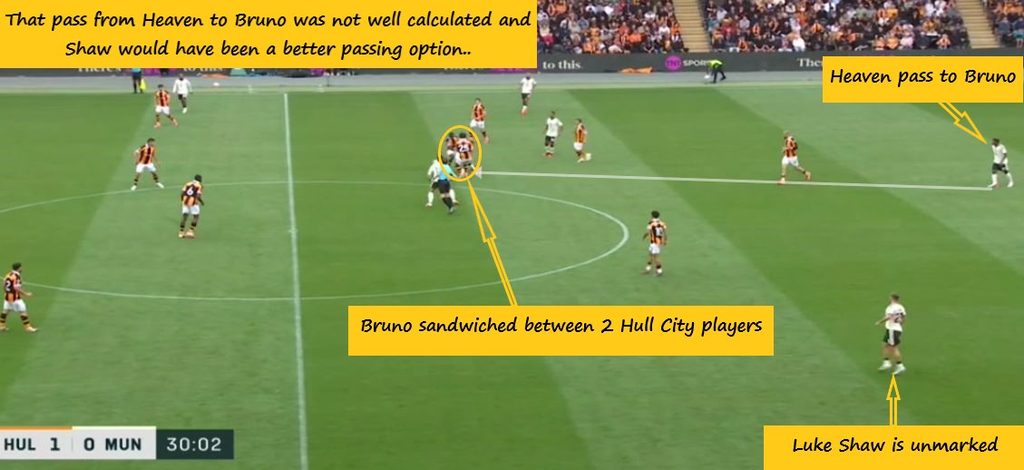
Hull City immediately surrounded him.
Two players converged on Bruno and physically sandwiched him as he tried to maintain his balance.
The ball was lost again. If anything, Heaven showed a lack of experience in this pass and tendency to hasten an attack unnecessarily – thus taking on too much risk.
At that stage, playing through the middle was becoming increasingly difficult for Michael Carrick’s side.
And it was not only Bruno Fernandes who suffered.
Hull City also applied pressure to Tielemans, preventing him from holding the ball for long enough to use the passing creativity that is supposed to make him valuable against compact defensive blocks.
The more time Manchester United spent trying to force their way through the middle, the more Hull City were able to close the available spaces.
The 54th minute produced another example where Manchester United lost the ball too easily.
Bruno received a pass from Mbeumo and appeared to attempt a dummy, allowing the ball to run past him in the hope that a teammate would collect it.
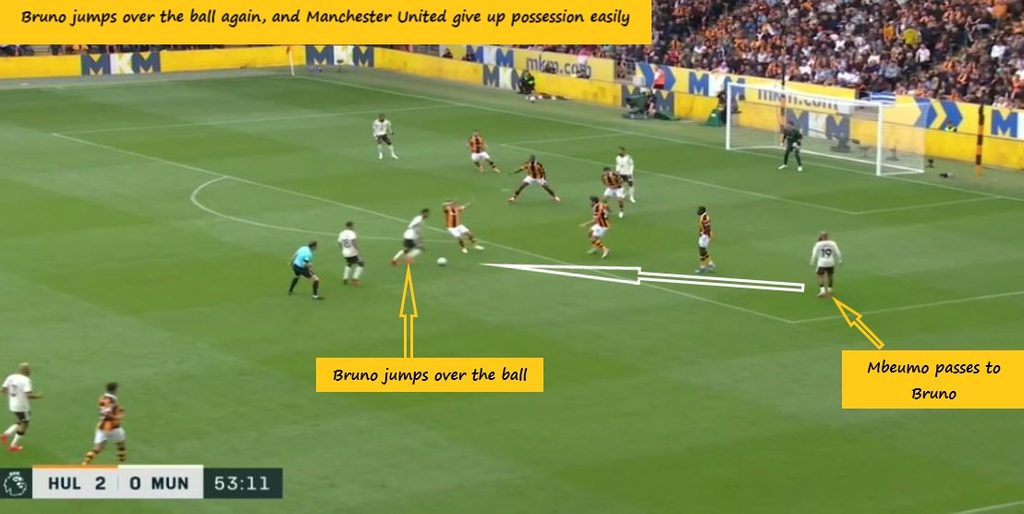
Nobody did.
In hindsight, Bruno would probably have been better served taking control of the ball rather than leaving possession for a teammate who was not there.
Hull City recovered possession and immediately threatened to counter.
Luke Shaw had to intervene and intercept the ball before the counter-attack became more dangerous.
That sequence demonstrates another problem with trying to force play against a compact defence.
A failed attacking action does not simply end an attack. It can also expose the team to a transition in the opposite direction.
Mbeumo then gave away possession in an even more avoidable manner, passing directly to a Hull City player positioned in front of him.
Could physical fatigue have contributed to mental fatigue and therefore to such a simple mistake?
It is difficult to know.
But repeated pressure inevitably increases the likelihood of poor decisions.
In the 57th minute, Bruno attempted another ambitious pass, this time looking for Rashford.
“Here is an example of Bruno Fernandes spraying the ball too far ahead in an over-ambitious attempt to progress play. Watch the example on X Perhaps these are habits borne out of frustration? But, certainly, this cannot be coming from a captain.“
The problem was the location from which he attempted it.
Bruno was only a few yards from Manchester United’s own 18-yard box and significantly closer to his own goal than the centre of the pitch, yet he was attempting to find Rashford, who was the team’s most advanced player.
The ball eventually ended up with the Hull City goalkeeper.
Rashford’s run was wasted and so was the attacking opportunity.
The pass looked less like a carefully constructed attacking move and more like an attempt born out of frustration — an attempt to bypass a Hull City midfield that had become increasingly difficult to penetrate.
That may also explain why Carrick introduced Sesko in the 67th minute.
Manchester United needed another way of bypassing the crowded central areas.
A target man could provide an outlet for longer passes and give the team a physical reference point against a defence that was already dominating the ground around the ball.
Even then, Hull City continued to deny Manchester United sufficient space.
At 92:07, Sesko attempted to compete for a cross, but even he struggled to find the room needed to jump and attack the ball in the manner expected of him.
The defence remained packed.
Manchester United Lost the Physical Battle in Ground Duels
If Hull City’s compact defending explains how they restricted Manchester United’s passing options, their physical approach explains why United repeatedly failed to escape those situations.
In the 25th minute, Tielemans attempted to drive the ball forward towards the edge of Hull City’s 18-yard box down the right.
It was arguably the next logical move.
But Hull City appeared ready for it.
Tielemans was physically challenged, pushed off balance and dispossessed, allowing Hull City to clear the ball away from danger.
This was precisely the kind of situation in which Manchester United needed a player to win the physical duel and continue the attack.
Some independent observers may have expected Tielemans, with his extensive Premier League experience, to put up more of a physical challenge.
A former Manchester United midfielder such as Casemiro, for example, would traditionally have been expected to embrace that kind of confrontation.
Tielemans had effectively been brought in to provide some of what Manchester United had previously received from Casemiro.
On this particular day, however, Hull City won that battle.
The same problem appeared in the 28th minute.
Dorgu was bundled over by a Hull City player while attempting to combine with Bruno Fernandes.
Mohamed Belloumi, wearing number 10, could almost casually watch the sequence unfold as Dorgu attempted to play the one-two with Bruno.
It was as though Belloumi already knew Dorgu would struggle to escape the physical pressure.
That is the striking feature of many of these duels.
Manchester United players often appeared to be favourites to control the ball when the contest began.
Yet time after time, Hull City players emerged with possession.
In the 41st minute, Mbeumo was physically challenged on the right wing by a Hull City player using an off-the-ball body charge.
It could easily have been given as a foul, but the referee allowed play to continue under advantage.
The commentator described it as a cheeky challenge designed to prevent Mbeumo from progressing after a one-two with Bruno Fernandes.
The effect was exactly what Hull City wanted.
As soon as Bruno saw Mbeumo go down, he was forced to retain possession for several more seconds, turning and twisting while searching for another passing option.
That slowed the attack.
And slowing the attack was enough.
Hull City did not always need to win the ball immediately.
Sometimes they simply needed to make Manchester United stop.
That challenge came after Mazraoui had made a sweeping tackle to win possession back for Manchester United.
Mazraoui’s effort showed that United were capable of matching Hull City physically in individual moments.
But collectively, Hull City appeared more prepared to engage in repeated physical confrontations, even when doing so carried the risk of committing fouls or receiving bookings.
That is not unusual in the Premier League.
The concern for Manchester United is that they appeared insufficiently prepared for that kind of contest.
The Premier League has long been regarded as one of the most physically demanding leagues in Europe. A Manchester United side with ambitions of competing at the top cannot afford to be surprised when an opponent turns the match into a battle of strength, second balls and ground duels.
Hull City were ready for that battle.
Manchester United were not.
Manchester United Also Lost the Aerial Battle
If there was one area in which the defeat became especially damaging, it was aerial play.
Both Hull City goals came from Manchester United’s inability to deal effectively with aerial situations.
That weakness also undermined Manchester United’s attacking strategy.
Crosses are only dangerous when there is a realistic possibility of a Manchester United player winning them.
Hull City’s defenders repeatedly positioned themselves to contest those balls, meaning Manchester United’s crosses were often neutralized before they could become genuine scoring opportunities.
This is where the introduction of Benjamin Sesko becomes particularly revealing.
Sesko offered Manchester United one of their strongest options in terms of aerial strength and physical presence.
But by the time Carrick introduced him, Hull City had already exploited the weakness.
The damage had been done.
The problem was therefore not simply that Manchester United lacked a tall striker.
The problem was that the team spent much of the match trying to attack a compact, physically aggressive and aerially strong defence without having sufficient presence inside the penalty area to make those deliveries count.
That made the crosses easier to defend.
It also made Manchester United’s attacks increasingly predictable.
The Numbers Back Up Hull City’s Physical Advantage
The visual evidence from the match was supported by the numbers.
By the half-hour mark, Manchester United had won 11 duels compared with Hull City’s 20.
Hull City had therefore won nearly twice as many duels as Manchester United.
The difference was also visible in tackles.
Manchester United had won only one tackle, while Hull City had won four.
Those numbers may appear small in isolation, but within the context of what was happening on the pitch, they reinforce the larger argument.
Hull City were not simply sitting deep and hoping Manchester United failed to score.
They were actively competing for the physical contests that determined whether Manchester United could progress the ball.
They were winning challenges.
They were closing passing lanes.
They were surrounding Manchester United’s attackers.
They were recovering their defensive shape quickly.
And when the ball went into the air, they were better equipped to compete for it.
Why Hull City Beat Manchester United
Ultimately, Hull City’s victory was built on several interconnected advantages rather than one decisive tactical trick.
Their low block denied Manchester United space.
Their compact defensive shape removed passing lanes.
Their close man-marking prevented Bruno Fernandes, Tielemans, Dorgu and the wide players from receiving the ball comfortably.
Their physicality made it difficult for Manchester United players to hold possession under pressure.
Their willingness to engage in ground duels disrupted Manchester United’s attempts to carry the ball into dangerous areas.
Their aerial strength neutralized crosses and ultimately contributed to both goals.
And because Manchester United could not establish a reliable attacking focal point, their attempts to break through the Hull City defence became increasingly predictable.
That is why this should not be remembered simply as a game Manchester United lost because of a few individual mistakes.
Individual errors undoubtedly mattered, and Bruno Fernandes himself addressed them.
But the larger story was collective.
Manchester United struggled to win the ball.
They struggled to keep it.
They struggled to progress it through the middle.
They struggled to create space on the wings.
They struggled to find players inside the penalty area.
And when they finally found a route towards the box, Hull City usually had enough players in position to close it.
The introduction of Sesko represented an attempt to change that dynamic by providing a physical target up front and a potential outlet for longer passes.
But Hull City had already established the conditions of the match.
They had turned the game into the kind of contest they wanted: compact, physical, congested and unforgiving.
Manchester United were dragged into that contest and repeatedly came out second best.
That is ultimately how Hull City beat Manchester United 2-0.
It was not merely about scoring two goals.
It was about making Manchester United’s preferred methods of attacking increasingly ineffective until the Red Devils were left relying on crosses, long passes, individual improvisation and increasingly desperate attempts to force their way through.
Hull City built the wall.
Manchester United spent much of the afternoon trying to find a way through it.
They never really did.
Hull City 2-0 Manchester United Stats: The Numbers Show Why Possession Did Not Translate Into Control
The final numbers make the contrast between the two teams even clearer. Manchester United finished the match with 71.6% possession, their highest share in a Premier League match since September 2023, according to Opta Analyst. They also attempted 654 passes to Hull City’s 252, completing 580 of them at an 88% accuracy rate compared with Hull’s 183 completed passes at 71%. Yet all that control of the ball produced no goals. Manchester United had 21 shots to Hull City’s eight, but only five of United’s attempts were on target, compared with four for Hull.
The difference becomes even more revealing when we look at where Manchester United had the ball. According to StatMuse, United had 40 touches inside Hull City’s penalty area, compared with just 11 for Hull. They also created 19 chances to Hull City’s five and won six corners to Hull’s one. On paper, those numbers look like the profile of the dominant team. But football is not decided by possession, passes or touches in the penalty area alone. It is decided by what a team does with those advantages. Manchester United repeatedly reached the areas from which they needed to create danger, yet Hull City kept them from turning that territory into goals.
Opta’s post-match analysis provides an even sharper illustration of the problem. Manchester United’s 21 shots were their second-highest total across their first two Premier League opening matches, yet they failed to score in both games. They also produced 34 open-play crosses, their highest total in a Premier League match for almost eight years. That is important because it supports what we saw throughout this match: once Hull’s compact low block made central progression difficult, Manchester United increasingly moved the ball wide and looked towards crosses as an alternative route into the penalty area. But with Hull packing the box and competing aggressively for aerial balls, a high volume of crosses did not necessarily mean a high volume of genuine danger.
The physical numbers also need to be read in context. During the opening half-hour, Manchester United had won only 11 duels to Hull City’s 20, while Hull had won four tackles to United’s one. Those were not final-match statistics; they were a snapshot of what was happening while the game was still being established. They showed Hull City setting the physical tone early, competing aggressively for the ball and repeatedly making Manchester United players uncomfortable when they tried to receive, turn or carry possession.
By full time, however, the tackle figures had changed. StatMuse recorded Manchester United with 17 tackles and 11 won, compared with Hull City’s six tackles and four won, while TNT Sports similarly recorded 17 successful tackles for Hull and six for Manchester United under its own statistical classification. The discrepancy between providers is precisely why the early figures should not be presented as proof that Hull won more tackles over the entire 90 minutes. The more meaningful point is that Hull’s early physical aggression helped establish the conditions of the match: Manchester United were made to work for every yard, and their attacking players were repeatedly forced into hurried decisions, difficult passes and physical contests.
The full-time duel numbers tell us something else. StatMuse recorded Manchester United winning 50 duels to Hull City’s 35 and 22 aerial duels to Hull’s 16. So this was not a simple case of Hull winning every physical statistic. Rather, Hull were more effective at choosing when and where to make the game physical. Their most important physical work came around their own penalty area, where they crowded Manchester United’s attackers, contested crosses and protected the spaces that mattered most. That distinction is crucial: a team can lose some of the overall statistical battles and still win the match because it wins the decisive moments.
And that is exactly what Hull City did.
Manchester United had more possession, more passes, more shots, more touches inside the opposition penalty area, more chances and more corners. Hull City had two goals. Both came from set-piece situations, with Semi Ajayi converting a corner in the 17th minute and Nobel Mendy finishing from a free-kick in the 38th. Opta’s post-match data also shows that Manchester United’s 1.81 expected goals came overwhelmingly from open play, while Hull City’s 1.19 expected goals came from set plays, reinforcing the tactical contrast between the two sides.
This is therefore not a story about Manchester United being unable to get into Hull City’s penalty area. They did. It is a story about what happened once they got there.
Hull City protected the central spaces, crowded the box, blocked eight of United’s shots, defended crosses in numbers and waited for opportunities from set pieces. Manchester United, meanwhile, accumulated attacking volume without the finishing efficiency or variety needed to turn that volume into goals. Their 21 shots looked impressive on the stat sheet, but only five were on target and none crossed the line. Hull managed just eight shots, four on target, yet scored twice.
That is the real lesson from the numbers. Manchester United won the possession battle. Hull City won the effectiveness battle.
The 30-minute statistics you identified during the match are therefore important because they captured the beginning of that story. Hull were setting the physical tone, disrupting United’s rhythm and making the Red Devils’ possession increasingly sterile. The final numbers then show how the match evolved: Manchester United accumulated more and more of the ball and attacking territory, but Hull continued to protect the areas that mattered and remained far more ruthless when their own opportunities arrived.
Manchester United had the ball.
Hull City had the moments that decided the game.
Conclusion: Manchester United Had the Ball, Hull City Had the Game
Hull City’s 2-0 victory over Manchester United should not be dismissed as a simple case of a newly promoted side defending deep and getting lucky.
There was a clear method behind it.
Hull recovered their defensive shape quickly, packed the penalty area, closed Manchester United’s passing lanes and stayed close to the players United needed to create danger. When Manchester United attempted to play through the middle, Hull compressed the space. When United went wide, Hull had enough bodies in the box to defend the cross. When United tried to carry the ball forward, Hull were prepared to turn the contest into a physical duel.
And when the game became a battle of aerial strength and set pieces, Hull were ready for that too.
That is why the final statistics are so revealing. Manchester United had 71.6% possession, 21 shots, 40 touches inside Hull’s penalty area, 19 chances and 654 passes. Yet they scored zero. Hull had only 28.4% possession and eight shots, but they scored twice.
The numbers do not show a Manchester United side that could not get forward.
They show a Manchester United side that could get forward but could not turn its dominance into decisive attacking actions.
That distinction matters.
Hull City did not need to dominate possession because their defensive structure allowed them to concede the ball in areas that were relatively harmless. They were willing to let Manchester United circulate possession outside the most dangerous zones, knowing that the closer United came to the penalty area, the more crowded and difficult the game would become.
Manchester United eventually resorted to crosses, producing 34 open-play deliveries — their highest total in a Premier League match for almost eight years — but Hull’s packed defence and aerial presence repeatedly neutralized that route. Even the introduction of Benjamin Sesko could not completely change the problem because the issue was bigger than simply having a taller striker. Manchester United needed space, better movement and cleaner routes into the penalty area. Hull gave them almost none.
This is also why blaming the defeat entirely on individual mistakes would miss the bigger picture.
Bruno Fernandes made questionable decisions. Other Manchester United players gave the ball away. Some attacking moves broke down unnecessarily. But those mistakes were happening within a broader tactical environment created by Hull City’s pressure, compactness and physical approach.
Hull made Manchester United uncomfortable.
They made them rush.
They made them play around the outside.
They made them cross.
They made them compete for second balls.
And, most importantly, they made Manchester United’s possession increasingly disconnected from actual scoring threat.
That is perhaps the most important lesson from this game.
Possession is not control if the opposition decides where you are allowed to use it.
Manchester United controlled the amount of time the ball was at their feet. Hull City controlled the spaces in which that ball could become dangerous.
And when the decisive moments arrived, Hull were ruthless.
For a newly promoted side facing a Manchester United team that had genuine ambitions of competing near the top of the Premier League, that is what makes this result so significant.
Hull City did not merely survive Manchester United’s pressure.
They understood it, absorbed it and ultimately used it against them.
Manchester United had the ball.
Hull City had the game.
Leave a Reply