
Introduction
Football is built on rivalry. On tribalism. On passion that spills from the stands onto the pitch and into every tackle, sprint, and celebration. The Premier League and European football thrive on moments of conflict — crunching challenges, heated exchanges, and fine margins that decide titles, relegations, and legacies.
But beyond the noise, the banter, and the relentless desire to win, there exists another side of the beautiful game — sportsmanship in football.
It is found in quiet gestures after the final whistle, in words of respect exchanged between fierce rivals, and in moments when empathy matters more than three points. From players acknowledging former coaches, opponents supporting each other through injuries, managers defending rival stars, to fans choosing compassion over mockery — these moments remind us why football is more than just a results-driven business.
This article highlights real-life examples of football sportsmanship, showing how respect, humility, and humanity continue to thrive even at the highest level of competition. Because sometimes, respect matters more than winning.
1. Jermain Defoe’s Gesture of Compassion Toward Wigan Athletic
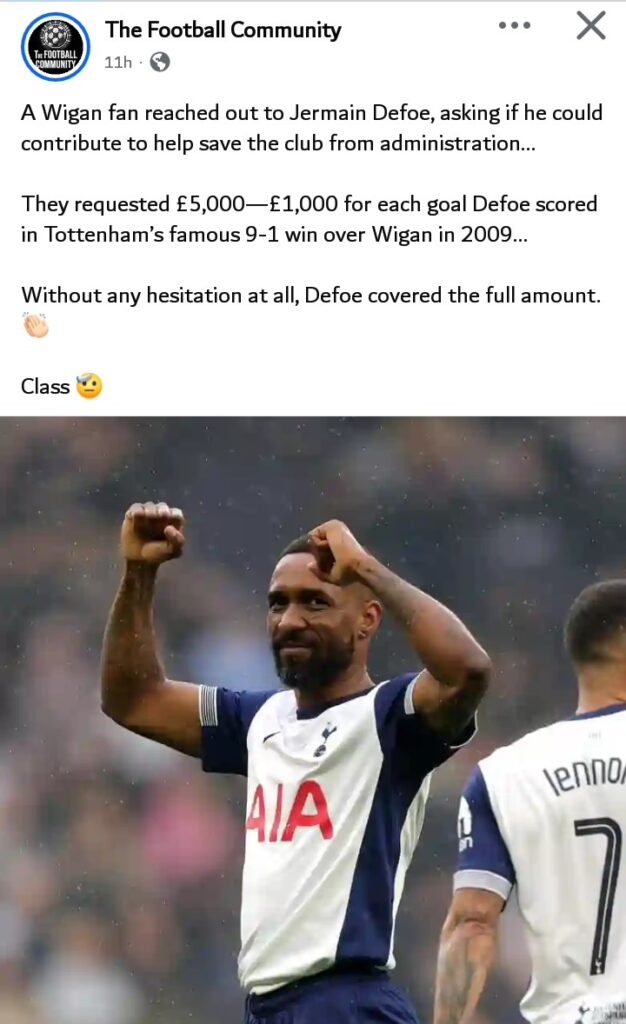
In November 2009, Tottenham Hotspur striker Jermain Defoe produced one of the most ruthless individual performances in Premier League history. Defoe scored five goals as Spurs demolished Wigan Athletic 9–1, a night that remains etched into English football folklore.
For Wigan, however, the defeat symbolised far more than just a heavy loss on the pitch. The club was already battling severe financial instability, with administration looming and the future of Wigan Athletic hanging in the balance.
In the aftermath of the match, a Wigan supporter reached out to Defoe on social media with a heartfelt request. As part of a fan-led crowdfunding campaign aimed at saving the club, the supporter asked Defoe to donate £1,000 for each goal he had scored against them — a total of £5,000.
Without hesitation, Defoe agreed.
The Tottenham striker immediately donated the full amount, turning a night of devastation for Wigan fans into a moment of unexpected kindness and solidarity. It was an act that transcended rivalry, scorelines, and club colours.
Although Wigan ultimately entered administration and suffered relegation, Defoe’s contribution played a meaningful role in supporting the supporters’ efforts and easing the club’s immediate financial burden.
More importantly, the gesture left a lasting impression. It reminded football fans that behind every badge and result are real communities, livelihoods, and people deeply affected by the game.
Jermain Defoe didn’t just score five goals that night — he showed that sportsmanship in football can matter far more than numbers on a scoreboard.
2. Athletic Bilbao Fans Show Class in Defeat Against Arsenal
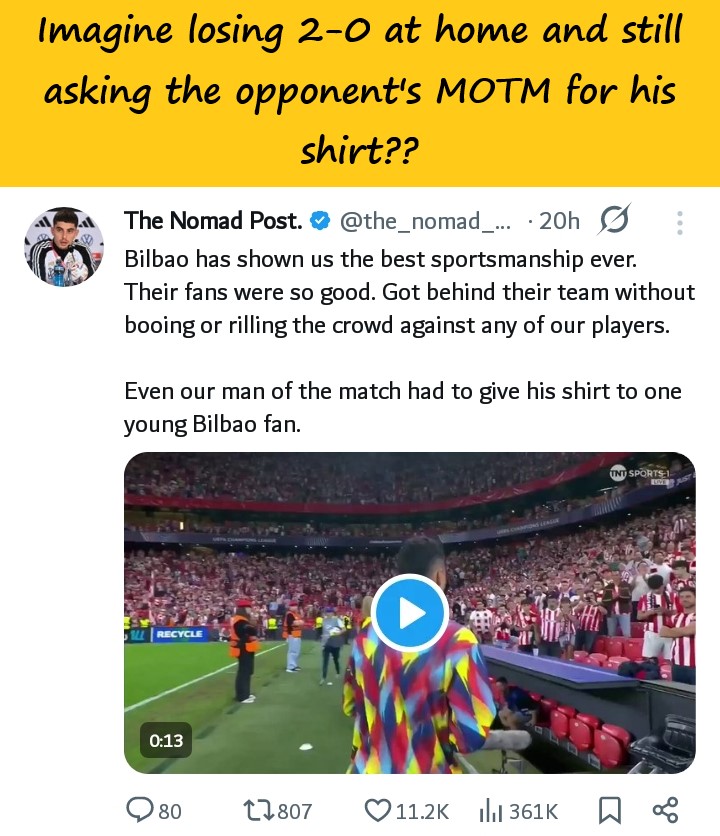
In September 2025, Athletic Bilbao welcomed Arsenal to the iconic San Mamés Stadium for a UEFA Champions League clash — a night charged with expectation, pride, and European ambition. On the pitch, however, it was Arsenal who emerged victorious, securing a 2–0 win, with Gabriel Martinelli delivering a standout performance that earned him the Man of the Match award.
Yet, the defining story of the evening did not come from the scoreboard.
Instead of frustration, whistles, or hostility — reactions often associated with home defeats on Europe’s biggest stage — the Athletic Bilbao supporters responded with remarkable dignity. Throughout the match, the San Mamés crowd stood firmly behind their team, offering unwavering support without once turning their anger toward Arsenal’s players.
There were no boos. No attempts to intimidate. No resentment aimed at the opposition.
What followed after the final whistle captured the spirit of football at its very best.
A young Athletic Bilbao supporter approached Gabriel Martinelli and asked for his shirt. The Arsenal winger, visibly moved, obliged without hesitation — a simple but powerful exchange that symbolised mutual respect between player and fan, victor and defeated.
The moment quickly resonated online, with one Arsenal supporter perfectly summing up the sentiment:
“Bilbao has shown us the best sportsmanship ever. Their fans were so good. Got behind their team without booing any of our players. Even the man of the match had to give his shirt to a young Bilbao fan.”
In a sport where disappointment can often breed hostility, Athletic Bilbao’s fans chose maturity, pride, and sportsmanship. They proved that supporting your team does not require tearing others down — even when the result goes against you, in your own stadium, under the brightest European lights.
Kudos to Athletic Bilbao’s supporters — a benchmark for football culture everywhere.
3. Mason Mount Chooses Respect Over Resentment
Mason Mount is Chelsea through and through. A Cobham graduate who joined the club at just six years old, he rose through the academy ranks, winning the FA Youth Cup and the UEFA Youth League before establishing himself in the first team. He became a Champions League winner, a key senior player, and an England international — the very definition of a homegrown success story.
That is why his move to Manchester United hurt so deeply.
For many Chelsea fans, Mount’s departure crossed an emotional line. The affection once reserved for one of their own disappeared almost instantly, replaced by boos and resentment whenever his name was mentioned.
Yet when Chelsea and Manchester United met for the first time during the 2025–26 Premier League season, Mason Mount offered a quiet reminder that football relationships extend beyond the stands.
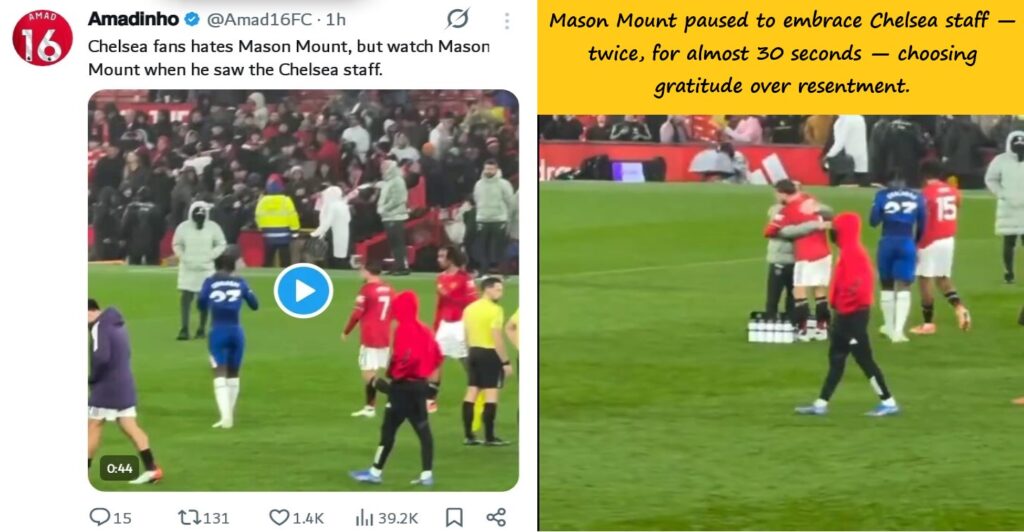
After the final whistle, Mount sought out a Chelsea staff member and embraced him — not once, but twice. The hug lingered. Arms rested on shoulders. Words were exchanged. It was not a fleeting gesture, but a moment that suggested gratitude, familiarity, and genuine affection. Mount did not look like a player in a rush to move on.
As one football fan observed while sharing the clip online:
“Chelsea fans hate Mason Mount, but watch Mason Mount when he saw the Chelsea staff.”
The video spread quickly, resonating with supporters across clubs. In a fixture charged with emotion, Mount chose respect over bitterness. He acknowledged the people behind the scenes who helped shape his career, even when his relationship with the fanbase appeared fractured beyond repair.
That is sportsmanship in football. Not forgetting where you came from. Not erasing human connections because of a transfer. And not allowing rivalry to override gratitude.
True sportsmanship.
4. Bukayo Saka and Marc Cucurella: Fierce Rivals, Mutual Respect
When Chelsea hosted Arsenal at Stamford Bridge in November 2025, one of the most captivating subplots unfolded down the flank. Bukayo Saka, Arsenal’s talisman and creative heartbeat, went toe-to-toe with Marc Cucurella, Chelsea’s relentless left-back, in a duel that defined the rhythm of the match.
For 90 minutes, it was intensity without compromise. Saka tested Cucurella with direct running, sharp changes of direction, and intelligent movement. Cucurella responded with aggression, positioning, and defensive discipline. Neither gave an inch. By full-time, the scoreboard read 1–1, and while it was impossible to declare a clear winner between the two, the contest itself was a triumph.
What followed, however, mattered just as much.
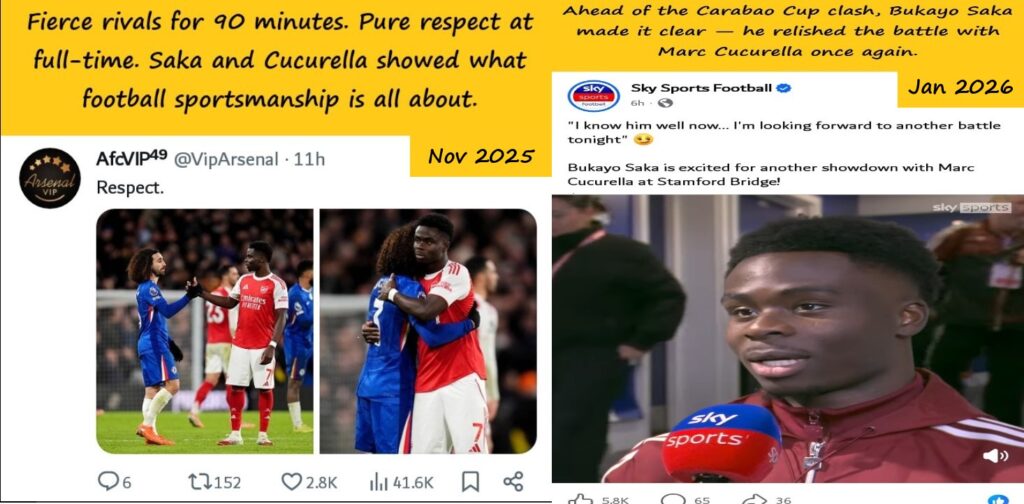
At the final whistle, Saka and Cucurella shook hands — a simple gesture that carried weight. After a night of physical battles, tactical fouls, and relentless pressure, both players acknowledged each other not just as opponents, but as professionals who had pushed one another to the limit.
Fast forward to January 2026, when Arsenal and Chelsea were drawn together again — this time in the Carabao Cup semi-final. Ahead of the clash, Bukayo Saka was asked about renewing his duel with Cucurella. His response was telling.
“I know him well now,” Saka said. “I am looking forward to another battle tonight.”
Sky Sports captured the moment perfectly with the caption:
“Bukayo Saka is excited for another showdown with Marc Cucurella at Stamford Bridge tonight.”
There was no animosity. No dismissiveness. Just respect.
Beyond the tackles and tactical chess match, Saka’s words revealed something deeper — an appreciation for the challenge Cucurella brings, and an understanding that elite competition is built on mutual recognition. He didn’t just expect the battle; he welcomed it.
That is sportsmanship in football.
Two fierce competitors. Two rivals in London colours. United by professionalism, respect, and a shared love for the contest itself.
5. William Saliba and Gabriel Magalhães Show Class with Hincapié
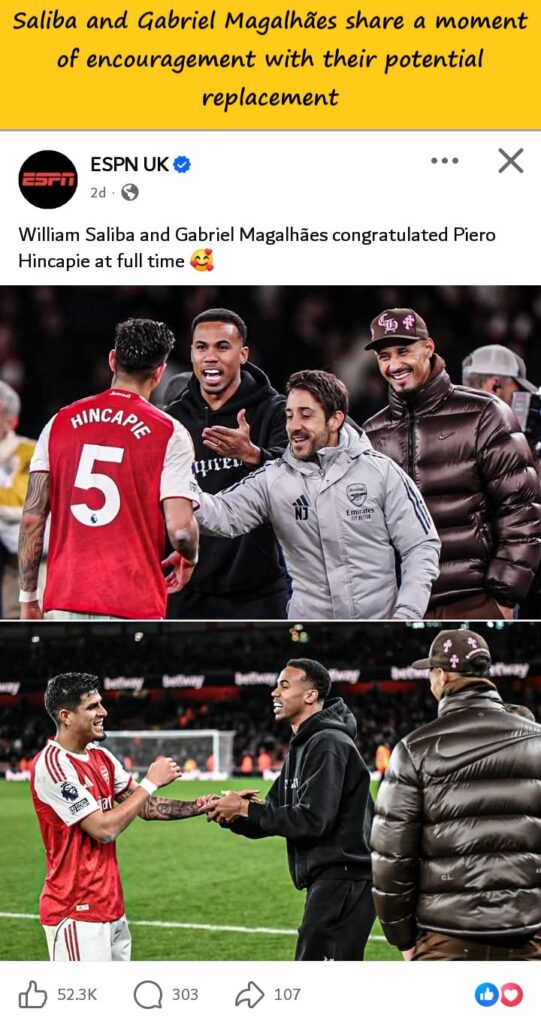
There is little debate in modern Premier League football: William Saliba and Gabriel Magalhães have formed the most dominant central defensive partnership in England over the last two seasons.
Arsenal’s defensive record speaks for itself — the fewest goals conceded, the highest number of clean sheets, and a backline that became the foundation of Mikel Arteta’s title-challenging side.
Yet football is ruthless, and depth is non-negotiable.
Scarred by an injury-ravaged previous campaign, Arsenal’s hierarchy moved decisively ahead of the 2025–26 season, reinforcing the defence by bringing in Piero Hincapié on loan from Bayer Leverkusen. It was a smart, proactive decision — one driven by protection, not replacement.
Ironically, fate had other plans.
During the 2025–26 season, both Saliba and Gabriel suffered injuries, forcing Hincapié into the starting XI. The Ecuadorian international was suddenly tasked with filling enormous shoes — stepping into one of the Premier League’s most demanding defensive systems, alongside elite expectations and unforgiving scrutiny.
Hincapié didn’t just survive — he performed.
Comfortable on the ball, aggressive in duels, and tactically disciplined, he showed why Arsenal trusted him. With enough minutes and adaptation, there is little doubt that Hincapié could one day push Gabriel Magalhães for a starting spot at centre-back.
But what followed after his standout performance revealed something far more important than competition.
Instead of insecurity, there was celebration.
Instead of tension, there was unity.
After the match in which Hincapié deputised for Gabriel, it was Gabriel Magalhães himself who looked happiest of all. Smiling, embracing, and visibly proud, the Brazilian defender celebrated Hincapié’s display as if it were his own.
In modern football, that reaction is rare.
Many players feel threatened when an understudy performs well. Some retreat inward. Others sharpen their elbows. But Gabriel chose generosity. He became Hincapié’s loudest supporter, not his silent rival.
There was no jealousy. No territorial instinct. Just mutual respect.
For Arsenal fans watching, it was a powerful reminder that elite dressing rooms are built not just on talent, but on character. Two defenders who could one day be fighting for the same position instead chose solidarity over selfishness.
In that moment, when William Saliba and Gabriel Magalhães couldn’t defend Arsenal’s goal — they defended the values of football itself.
Because true sportsmanship isn’t about fearing competition.
It’s about lifting those beside you — even when they might one day challenge you.
6. Xavi Simons Shows Accountability After Costly Red Card for Tottenham
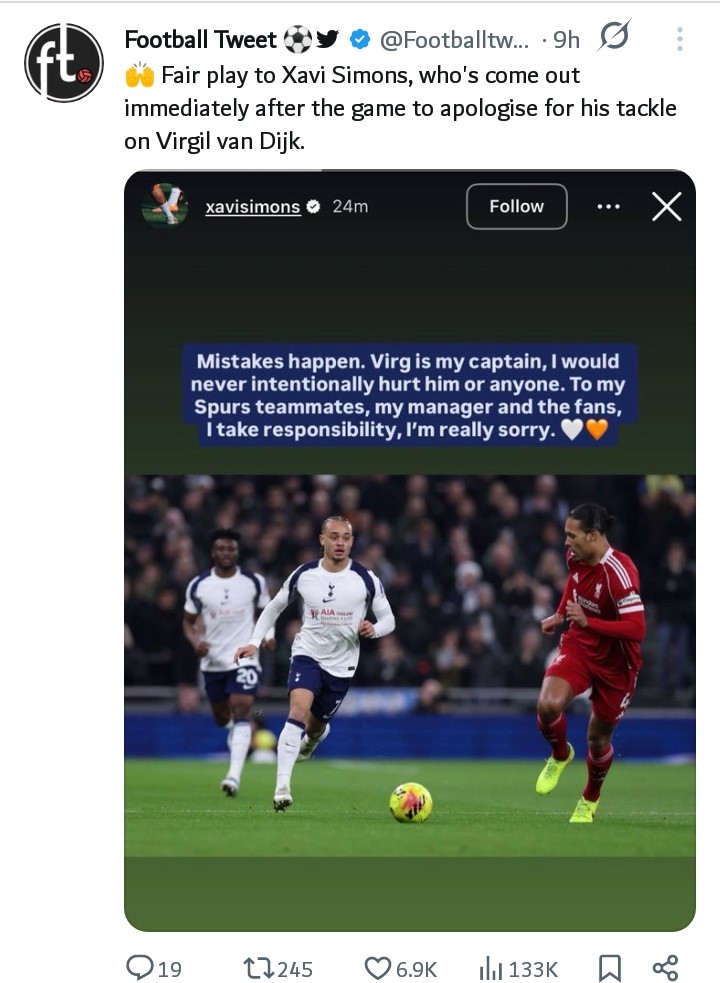
When Tottenham Hotspur committed £51.8 million to sign Xavi Simons from RB Leipzig, expectations were immediate and unforgiving. Simons arrived in North London as a marquee addition — a statement signing meant to inject creativity, intensity, and elite mentality into Spurs’ midfield.
But football has a brutal way of testing character.
In December 2025, when Tottenham hosted Liverpool at White Hart Lane, Simons endured one of the toughest moments of his young Premier League career. In a fiercely contested match, the Dutch midfielder was shown a red card in the 33rd minute after a reckless and dangerous challenge on Virgil van Dijk — a dismissal that left Spurs vulnerable and ultimately contributed to a 2–1 defeat.
For many players, that moment becomes a defensive exercise. Complaints about officiating. Claims of harsh punishment. Private apologies limited only to teammates.
Xavi Simons chose a different path.
Rather than deflecting blame, he owned the mistake completely. First, he reached out to Virgil van Dijk, the very player he had wronged — a significant gesture, given that Van Dijk is not only a rival on the pitch, but also Simons’ captain with the Netherlands national team. Only after that did he turn his attention to his own dressing room.
In a public statement shared on social media, Simons took full responsibility:
“Mistakes happen. Virg is my captain. I would never intentionally hurt him or anyone. To my Spurs teammates, my manager and the fans, I take responsibility. I’m really sorry.”
Those words carried weight.
By acknowledging fault, expressing genuine remorse, and showing respect to his opponent, Simons defused what could have become a lingering controversy. The apology wasn’t forced. It wasn’t vague. It was personal, direct, and mature.
In a sport where ego often delays accountability, saying sorry takes courage — especially when it means addressing the very player you were battling minutes earlier.
Xavi Simons reminded everyone that sportsmanship in football isn’t about perfection. It’s about how you respond when you fall short. By owning his mistake instead of hiding from it, he shifted the narrative — from reckless villain to responsible professional.
And sometimes, that single act of honesty is enough to close the chapter — on and off the pitch.
7. Declan Rice Shows Gratitude to David Moyes After Beating Everton
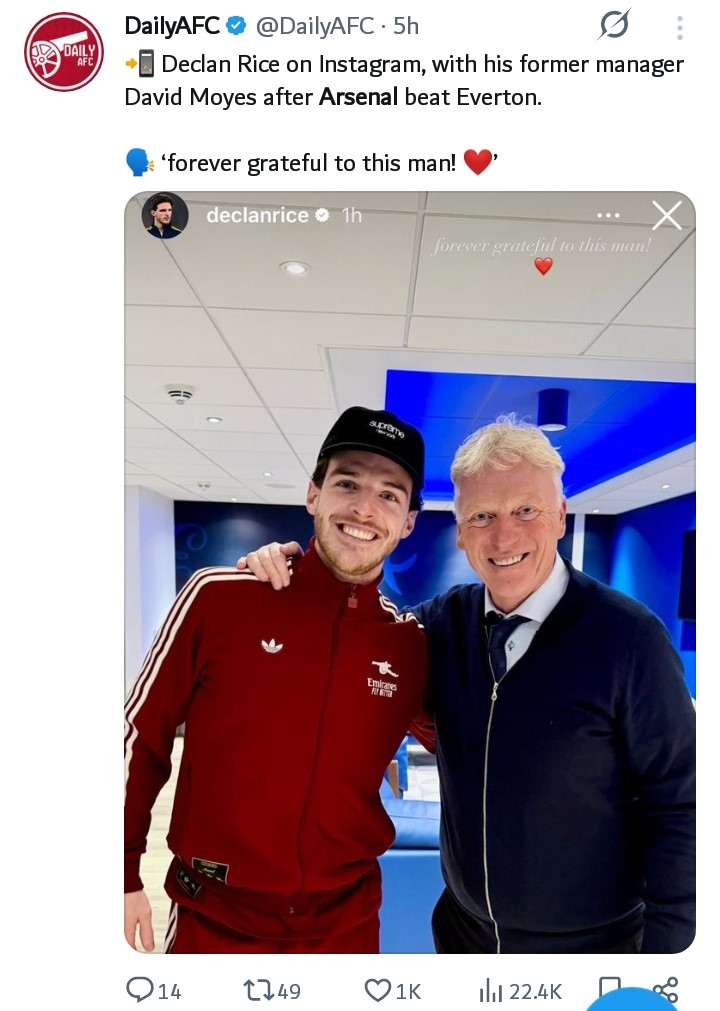
Not every football relationship ends when a player leaves a club. Some bonds run deeper than contracts, transfers, or results — and Declan Rice’s relationship with David Moyes is one of them.
Although Moyes never coached Rice at Everton, he was instrumental in shaping the midfielder’s career at West Ham United. Under Moyes’ guidance, Rice evolved from a promising academy graduate into a commanding Premier League midfielder — a leader, a captain, and eventually, one of the most valuable players in English football.
So highly did Moyes rate him that when Rice completed his £105 million move to Arsenal, the veteran manager joked that West Ham had undersold him.
“When I see Arsenal supporters, I tell them they still owe me £50 million,” Moyes said.
“We only got £100 million for him. He has proven exactly what we thought he was — a top player.”
Those words were backed by belief, not bitterness.
Fast forward to December 2025, when Everton hosted Arsenal in the Premier League. By then, David Moyes had returned to Goodison Park, tasked with reviving Everton’s fortunes. Arsenal edged the contest 1–0, securing another important victory in a tightly contested season.
But once the final whistle blew, Declan Rice made sure football results didn’t overshadow human respect.
The Arsenal midfielder sought out his former manager on the touchline, greeting Moyes warmly before later posting a photo of the two together on Instagram. His caption was simple, powerful, and deeply personal:
“Forever grateful to this man.”
It was a moment that resonated far beyond the scoreline.
Rice has never hidden how pivotal Moyes was to his development — mentally, tactically, and professionally. The discipline, leadership, and authority that now define his game were forged during those years at West Ham.
And even after defeating a resurgent Everton side led by the man who helped build his career, Rice didn’t hesitate to give credit where it was due.
In modern football, where loyalty is often questioned and gratitude is rarely public, Declan Rice offered a refreshing reminder: success does not erase your roots.
That moment at Goodison Park wasn’t just about respect for a former manager — it was about acknowledging the people who help shape your journey. And that, more than any pass or tackle, is true sportsmanship in football.
8. Mikel Arteta, Everton, and David Moyes: Respect That Transcends Rivalry
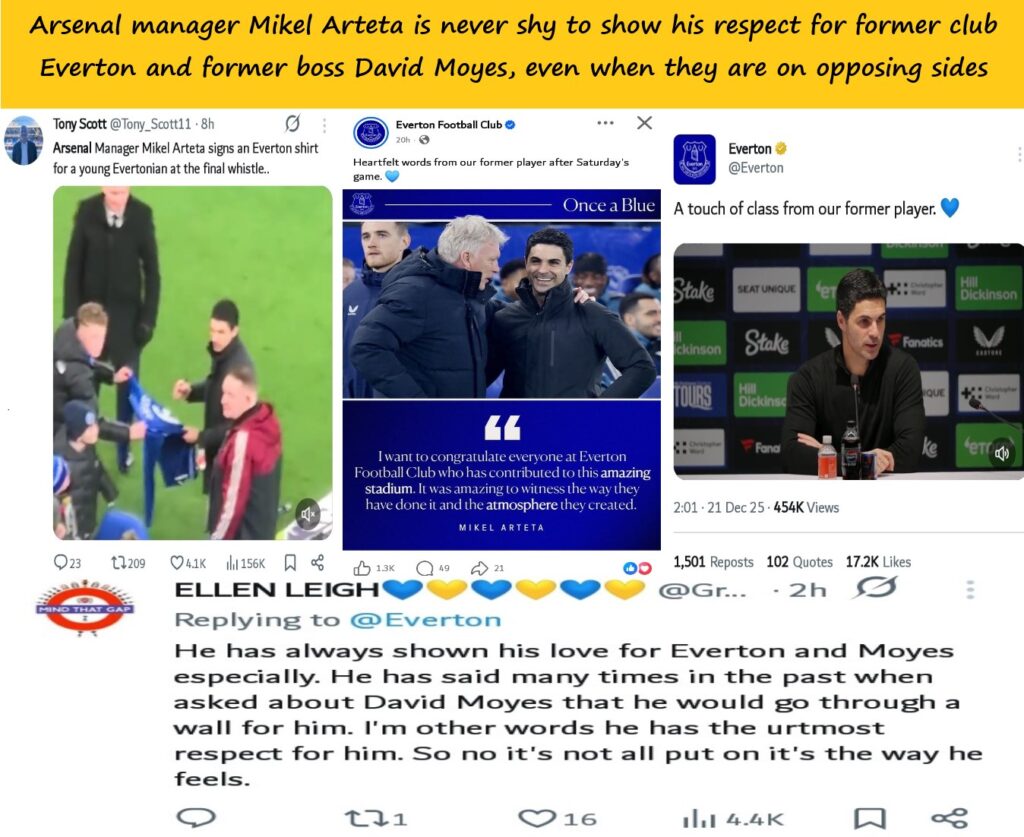
Long before Mikel Arteta emerged as one of the Premier League’s most progressive young managers, he was a midfielder trying to establish himself at the highest level. And among the first coaches in English football to truly believe in his potential was David Moyes.
During Arteta’s time at Everton, Moyes entrusted him with responsibility, leadership, and influence in midfield — qualities that would later define Arteta’s managerial philosophy at Arsenal. That bond has never faded.
As one football fan perfectly summed it up:
“He has always shown his love for Everton and Moyes especially. He has said many times in the past when asked about David Moyes that he would go through a wall for him. In other words, he has utmost respect for him.”
That respect has consistently been visible whenever Arsenal face Everton — not just in Arteta’s demeanor on the touchline, but in his words away from it.
So when Mikel Arteta’s Arsenal came up against David Moyes’ Everton this season, the Arsenal manager once again made it clear that history and gratitude matter more than rivalry.
Following the match, Arteta took time in his post-match press conference to praise Everton — particularly their monumental move to a new stadium, acknowledging the scale of the project and the immense challenges the club had overcome to make it a reality.
His comments carried even more weight given Everton’s recent struggles off the pitch.
On 8 April 2024, Everton were handed their second Premier League points deduction of the season, this time a two-point penalty after a Commission found the club had incurred losses of £121.6 million during the 2022/23 financial year.
That ruling followed an earlier and even more severe punishment in November 2023, when an independent Commission imposed an immediate 10-point deduction for breaching the Premier League’s Profitability and Sustainability Rules (PSR) — the first time Everton had ever been docked points in the competition.
Despite those setbacks — and despite being opponents on the day — Arteta chose to highlight Everton’s resilience rather than focus solely on his own team.
“I want to congratulate everyone at Everton Football Club who has contributed to this amazing stadium,” Arteta said.
“It was incredible to witness the way they have done it and the atmosphere they have created.”
It would have been easy for Arteta to ignore his former club and former manager, shift the spotlight back to Arsenal, and move on. Instead, he paused to acknowledge achievement, perseverance, and legacy.
In doing so, Mikel Arteta once again demonstrated that true sportsmanship in football isn’t limited to handshakes at full-time. Sometimes, it’s about recognising the people and places that shaped you — even when they now stand on the opposite side of the technical area.
9. James Maddison and Bruno Fernandes: Mutual Respect Among Premier League Playmakers
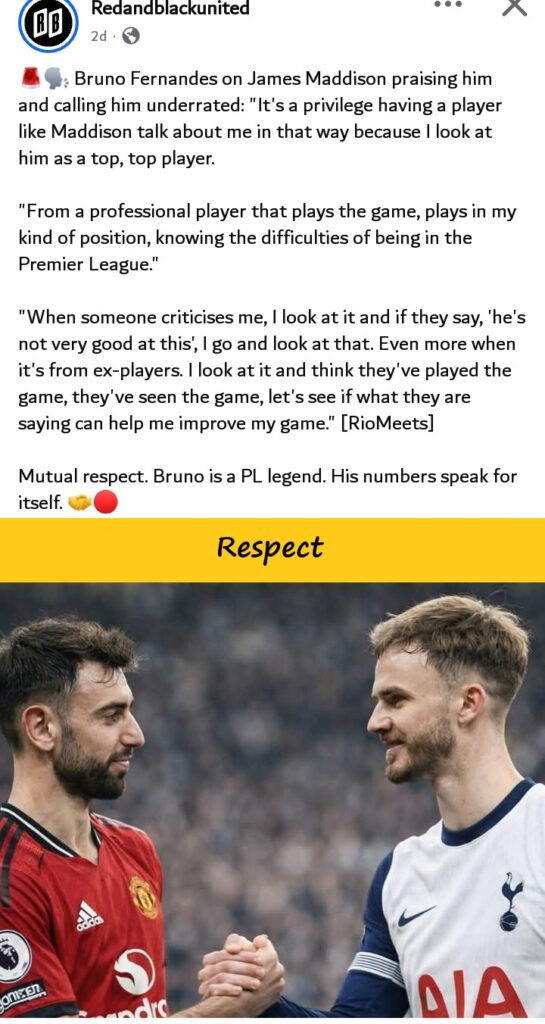
In a league often defined by rivalry and comparison, moments of genuine respect between elite players stand out — and James Maddison’s praise of Bruno Fernandes in December 2025 was one such moment.
Speaking after Bruno Fernandes’ standout performance against Wolves, Maddison described the Manchester United captain as “underrated”, despite his long-standing influence in the Premier League.
“I think he is underrated,” Maddison said.
“He is still underrated for the quality he shows consistently. Every time he is on the ball, he can just see it all.”
The comments carried extra weight given that Maddison and Fernandes operate in similar creative roles and represent rival clubs, making such open admiration rare at the elite level.
Bruno Fernandes was quick to acknowledge the praise, admitting that it is not every day a player competing in the same position — and in the same league — publicly recognises your quality.
“It’s a privilege having a player like Maddison talk about me in that way,” Bruno said.
“Because I look at him as a top, top player.
“From a professional player that plays the game, plays in my kind of position, knowing the difficulties of being in the Premier League.”
Rather than downplaying the compliment, Fernandes returned it with equal respect — a reminder that top-level footballers understand the demands, scrutiny, and responsibility that come with being a creative fulcrum in the Premier League.
This exchange was not about clubs, rivalries, or headlines. It was about two of the Premier League’s finest creative playmakers acknowledging excellence when they see it — even when it belongs to someone on the other side.
In a competition as intense and unforgiving as the EPL, that level of mutual respect speaks volumes.
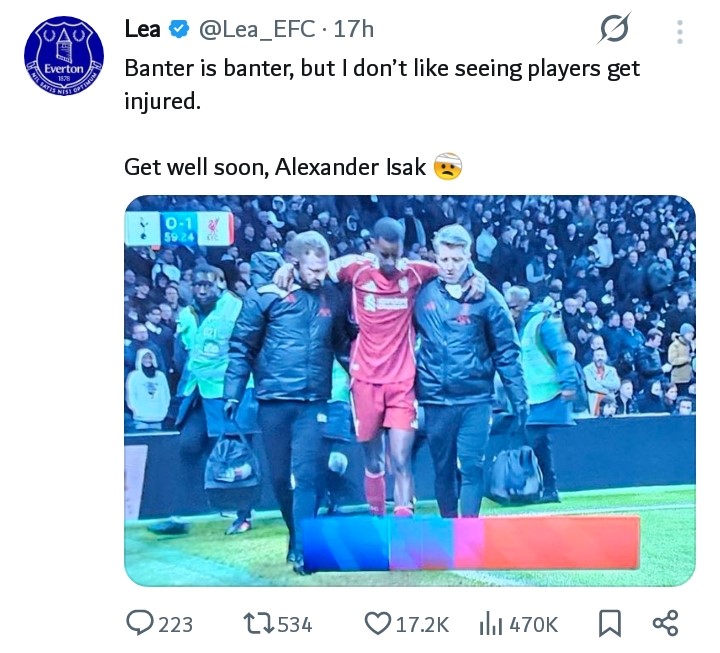
10. A Vocal Everton Fan Shows Sympathy for Liverpool’s Alexander Isak
Alexander Isak has established himself as one of the most lethal strikers in the Premier League over the past few seasons. His rise began at Newcastle United, where his goalscoring numbers made him one of the most sought-after forwards in Europe, before sealing a British-record move to Liverpool in September 2025, reportedly worth £125 million and rising to £130 million with add-ons — one of the biggest transfers in football history.
Expectations were enormous. Isak was widely tipped to elevate Liverpool’s frontline, having scored 21 goals in 30 appearances during the 2023–24 season, followed by 23 goals and six assists in 2024–25 for Newcastle. His pace, movement, and finishing made him the ideal modern No.9.
However, since arriving at Anfield, Isak’s momentum has been disrupted by injury and fitness setbacks, preventing him from finding rhythm or consistency in a Liverpool shirt.
In a moment that cut through tribal rivalry, one vocal Everton supporter — fully aware of the fierce Merseyside divide — chose empathy over mockery following Isak’s latest injury setback.
The fan wrote on social media:
“Banter is banter, but I don’t like seeing players get injured. Get well soon Alexander Isak.”
It was a simple message, but a powerful one. In a rivalry often defined by hostility, the comment reminded everyone that there is a line between football banter and basic human decency.
Even among the most passionate fans, there is an understanding that a player’s health and career matter more than points, bragging rights, or rivalry. In that moment, football loyalties were set aside — and respect took centre stage.
Sometimes, true sportsmanship is not shown by players or managers, but by the fans themselves.
11. Morgan Rogers Shows Support for a Young Manchester United Debutant
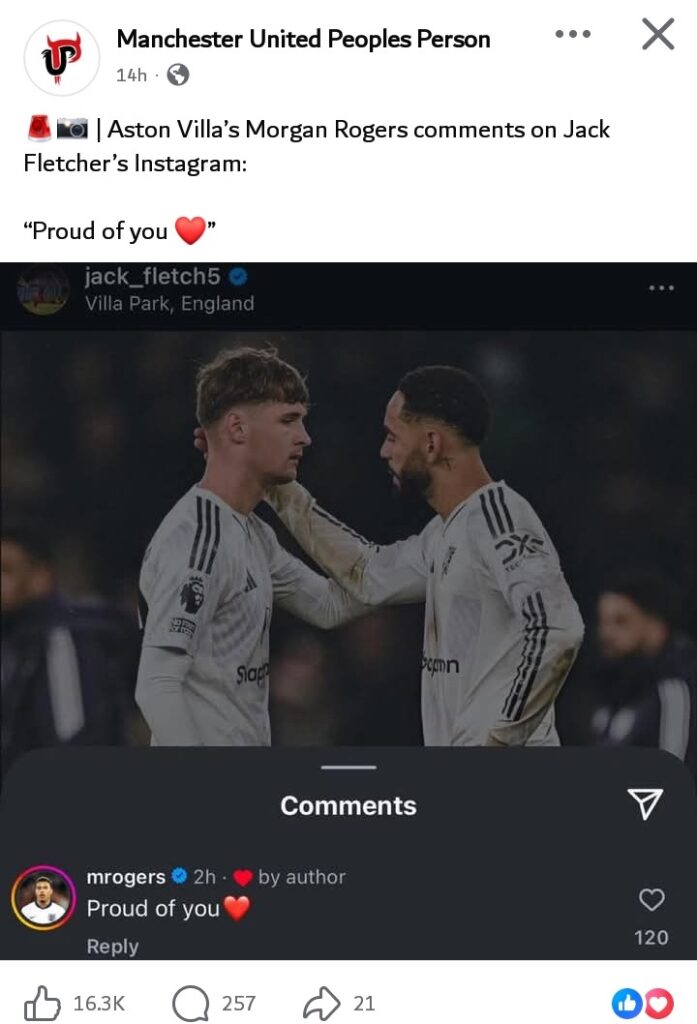
When Manchester United suffered defeat to Aston Villa in the Premier League in December 2025, the result itself offered little comfort to United supporters. However, amid the disappointment, there was one genuine moment of optimism — 18-year-old Jack Fletcher made his senior debut for Manchester United.
The young midfielder, son of former United stalwart Darren Fletcher, stepped onto the Premier League stage hoping to follow in his father’s footsteps after a distinguished career at Old Trafford. For a teenager taking his first steps at the highest level, encouragement and reassurance from senior professionals can be just as important as minutes on the pitch.
What happened next surprised many.
Despite being on the opposing side, and despite having just delivered a match-winning performance against United, Aston Villa’s Morgan Rogers took time to publicly acknowledge and support the young debutant on social media.
Rogers had enjoyed a standout night himself — scoring twice against Manchester United, helping Villa secure a 2–1 victory, and ultimately walking away with the Man of the Match award. He had every reason to focus solely on his own moment in the spotlight.
Instead, Rogers chose to share it.
By publicly backing Jack Fletcher, Rogers showed that respect for a young professional transcends club colours and match-day rivalries. Even after a fiercely contested Premier League clash — one he had trained all week to win — Rogers demonstrated maturity and class by lifting up an opponent at the very beginning of his career.
It was a powerful reminder that true sportsmanship isn’t only shown in handshakes or apologies — sometimes, it’s shown by using your moment of success to encourage someone else’s first step.
12. Erling Haaland: A Nice Guy, Even When He Isn’t Scoring
Erling Haaland may be one of the most ruthless goal scorers football has ever seen, but away from the numbers, many fans and players alike continue to point out another side of the Manchester City striker — his humility and genuine character.
Haaland has often been praised for how enthusiastically he celebrates his teammates’ goals, even on days when he himself doesn’t get on the scoresheet. There is never a sense of ego or frustration; instead, there is visible joy in collective success.
That humility was on display again recently when Antoine Semenyo arrived at Manchester City. Rather than asserting his dominance as the club’s undisputed No.9, Haaland welcomed the new forward warmly, even joking that Semenyo had what it takes to take the Golden Boot from him — a rare statement from a player who dominates scoring charts year after year.
But perhaps the most telling moment came away from City altogether.
During a turbulent period in Mohamed Salah’s Liverpool career in the 2025–2026 season — marked by public criticism of head coach Arne Slot, questions over his role in the team, and uncertainty about his future before departing for the Africa Cup of Nations — Haaland showed quiet but meaningful support.
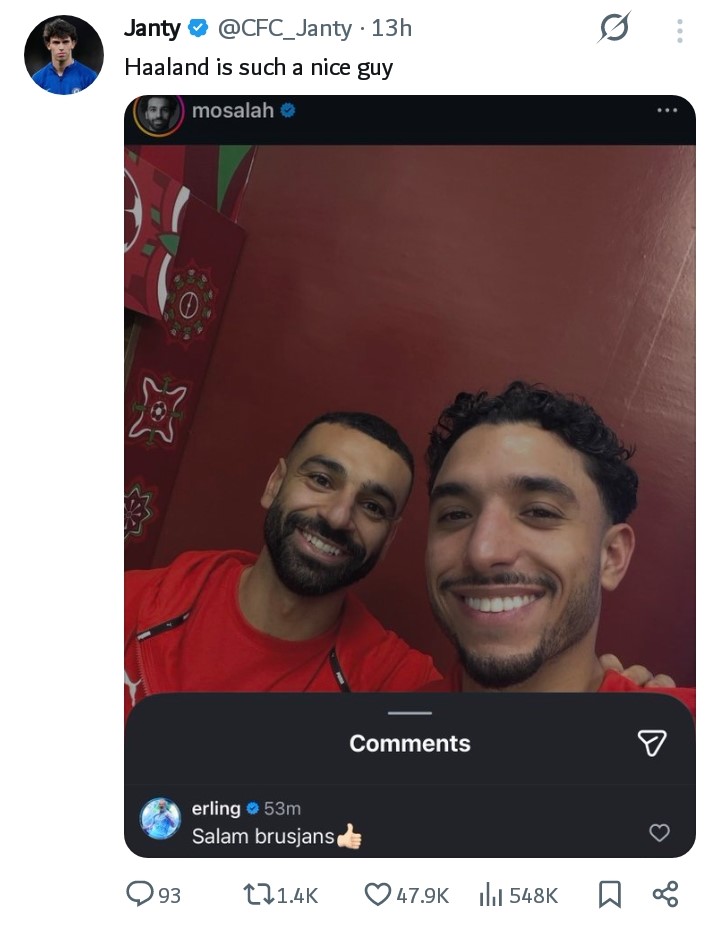
Despite the fact that Manchester City and Liverpool have been direct title rivals, and that Haaland and Salah have been Golden Boot competitors, the Norwegian striker was among the first players to comment on Salah’s Instagram post during that difficult moment.
Salah had shared a photo with an Egyptian teammate while away on international duty. Haaland’s response was simple, cheerful, and heartfelt:
“Salam brusjans 👍” — meaning peace, brothers.
It may have been a short comment, but its meaning was clear. At a time when Salah was under pressure, criticized, and emotionally exposed, one of his fiercest on-pitch rivals chose empathy over rivalry.
To many fans, that spoke volumes.
As one supporter summed it up online: “Haaland is such a nice guy.”
The comment quickly gained traction, with countless fans agreeing that behind the goals, records, and trophies, Erling Haaland continues to show why respect and humanity still have a place at the very top of modern football.
13. Raheem Sterling: Loving the Game Even When His Career Isn’t at Its Best
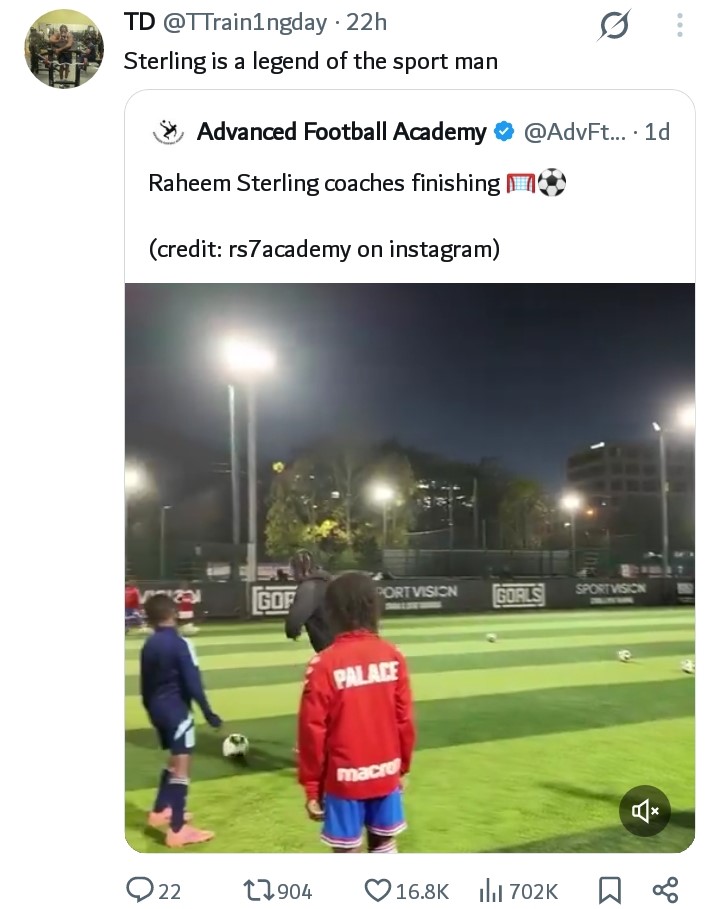
There is no question that Raheem Sterling has been one of the Premier League’s most explosive and accomplished wingers of the modern era. From his early rise at Liverpool to his trophy-laden peak at Manchester City, Sterling established himself as a relentless wide forward — direct, intelligent, and decisive in the final third.
However, football is rarely a straight line.
In recent seasons, Sterling’s career has faced a downturn. After his move to Chelsea, the England international found himself increasingly on the fringes, eventually being frozen out of the first team under former head coach Enzo Maresca. Minutes dried up, momentum stalled, and the spotlight shifted away from a player once considered among the elite attackers in the EPL.
Yet even during this difficult period — when Sterling was not playing regular Premier League football — his love for the game never faded.
A video surfaced online showing Sterling working closely with young footballers, patiently giving instructions, correcting movement, and sharing knowledge gained from years at the very top of English football. There was no camera-chasing, no publicity stunt — just a seasoned professional passing on lessons to the next generation.
It was a powerful sight: a player whose own career had hit turbulence, still choosing to give back to football, still invested in developing young talent, still teaching the fundamentals of movement, awareness, and discipline long before thoughts of retirement.
That moment resonated deeply with fans.
As one supporter perfectly captured online: “Sterling is such a legend of the game, man.”
Because sometimes, true sportsmanship isn’t shown under floodlights or measured in goals and trophies — it’s revealed in how a player treats the game when it stops giving back.
14. Liverpool Head Coach Arne Slot Defends Arsenal’s Gabriel Martinelli
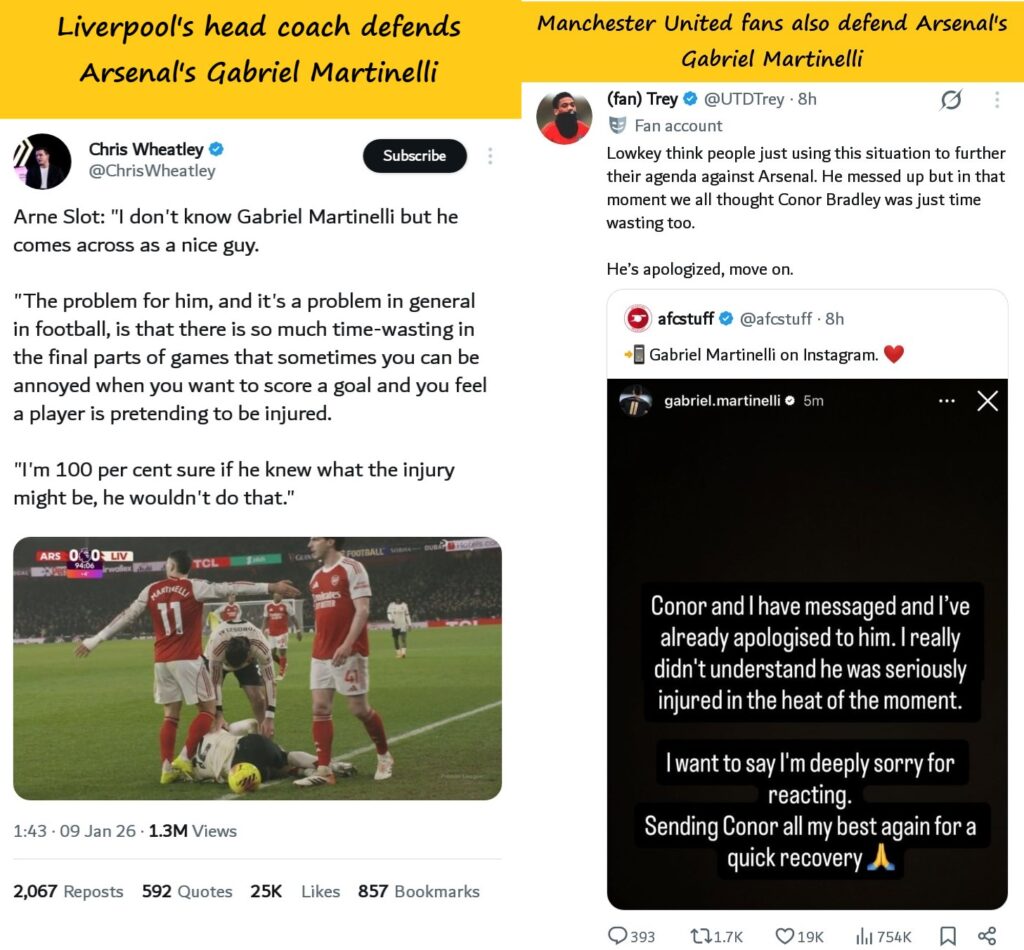
You would hardly believe it — but this was one of the clearest examples of sportsmanship rising above rivalry in modern Premier League football.
When Arsenal hosted Liverpool at the Emirates in a high-stakes EPL clash, emotions were running at boiling point. Arsenal were pushing desperately for a late goal, knowing victory would help them extend their lead at the top of the table as they chased a Premier League title that has eluded them for over two decades.
In the dying minutes, Liverpool’s Conor Bradley went down injured near the touchline. At first glance, it appeared to many — including Arsenal winger Gabriel Martinelli — that the Liverpool defender was attempting to waste time. Acting in frustration, Martinelli tried to lift or push Bradley off the pitch so play could continue.
What Martinelli didn’t realize in that moment was that Bradley had suffered a genuine and serious injury. Once the severity became clear, the reaction was swift and unforgiving. Social media erupted, with sections of the football world openly baying for Martinelli’s blood, condemning his actions as reckless and unsporting.
To his credit, Martinelli quickly held his hands up, issuing a public apology for the incident and acknowledging his mistake.
What followed, however, surprised almost everyone.
Instead of fueling the outrage — especially considering it was a Liverpool player who had been injured — Liverpool head coach Arne Slot chose empathy over emotion. In a moment that perfectly captured the theme of sportsmanship, Slot publicly downplayed the incident and came to Martinelli’s defence.
Slot said:
“I don’t know Gabriel Martinelli, but he comes across as a nice guy.”
“The problem for him — and it’s a problem in general in football — is that there is so much time-wasting and players pretending they are injured in the final moments of games.”
“When you are desperately trying to score in the 94th minute, you can get frustrated. You cannot ask Martinelli to think clearly in that moment.”
It was a measured, human response — one that refused to jump on the outrage bandwagon and instead acknowledged the realities of modern football.
Even neutral fans noticed.
One Manchester United supporter summed it up perfectly online:
“Low-key, I think people are just using this situation to push their agenda against Arsenal. He messed up, but most of us thought Bradley was time-wasting too. He apologized. Move on.”
The fan even shared Martinelli’s apology to reinforce the point.
This was true sportsmanship — not pretending mistakes don’t happen, but recognizing that footballers are human, emotions run high, and genuine errors deserve understanding when accountability is shown.
In a sport often driven by tribalism and outrage, Arne Slot reminded everyone that respect still has a place in football.
Conclusion
In an era where football is often dominated by outrage, tribalism, and social media pile-ons, these moments stand out like beacons of what the game should represent.
From players putting rivalry aside to show mutual respect, to managers defending opponents, fans showing empathy across derby lines, and professionals owning up to mistakes — each story in this article proves one thing clearly: football is at its best when humanity leads the way.
Winning trophies, breaking records, and lifting silverware will always matter. But legacies are shaped just as much by character as they are by medals. Sportsmanship in football reminds us that behind every badge, every kit, and every rivalry, there are human beings who share the same love for the game.
These are the moments that outlive the scorelines.
The moments fans remember.
The moments that truly make football… the beautiful game.
Leave a Reply