
Arsenal left Villa Park with a valuable 1-0 victory, but the result did little to disguise a concerning Christos Tzolis performance on the left wing.
Just eight or nine days after producing an outstanding Premier League debut against Coventry, the Arsenal winger struggled badly against Aston Villa and was substituted before half-time.
Tzolis had offered plenty of encouragement on his Arsenal debut against Coventry, as I discussed in my earlier analysis of his first Premier League appearance.
But the contrast was striking.
Against Coventry, Tzolis looked confident, aggressive and decisive. He was heavily involved in Arsenal’s attacking play and appeared to have made an immediate impression after joining the club. His performances in pre-season, including the Community Shield against Manchester City, had also suggested that Arsenal had found an exciting attacking option capable of making an immediate impact.
At Villa Park, however, almost none of that confidence was visible.
Tzolis struggled to influence Arsenal’s attack, lost several physical duels, failed to complete key dribbles, was unable to produce a threatening cross and was eventually booked after losing possession in a situation that could have turned disastrous for Arsenal. His defensive concentration also came into question.
There are understandable explanations. Tzolis is still adapting to the physical demands and intensity of English football, and fatigue could be a factor given the demands placed on a new player so early in the season.
But the scale of the drop-off is difficult to ignore.
Christos Tzolis Performance: A Huge Drop-Off From His Arsenal Debut
The biggest concern from the Aston Villa game was not simply that Tzolis had a poor match. Every player has bad games.
It was how different this performance looked from the player Arsenal fans had seen only days earlier.
Against Coventry, Tzolis looked comfortable receiving the ball, attacking defenders and getting involved around the penalty area.
Against Aston Villa, he repeatedly appeared hesitant, struggled to win physical contests and made several decisions that placed Arsenal under unnecessary pressure.
The left side of Arsenal’s attack was particularly quiet during his time on the pitch.
From the opening stages of the match, Arsenal’s most dangerous attacking combinations were predominantly developing on the right, where Bukayo Saka, Ben White and Martin Ødegaard were heavily involved.
That left Tzolis with fewer opportunities to influence the game offensively, but the winger also failed to make enough of the moments that did come his way.
More importantly, his problems were not restricted to attacking output. There were several moments when his positioning, physicality and decision-making became concerns.
The first came almost immediately.
Tzolis’ Lapse in Judgement and Concentration
From the opening seconds through the early stages of the match, Arsenal’s attacking play was largely concentrated on the right side.
Then, at around the 2:05 mark, Aston Villa won possession and Tzolis appeared to lose track of Matty Cash.
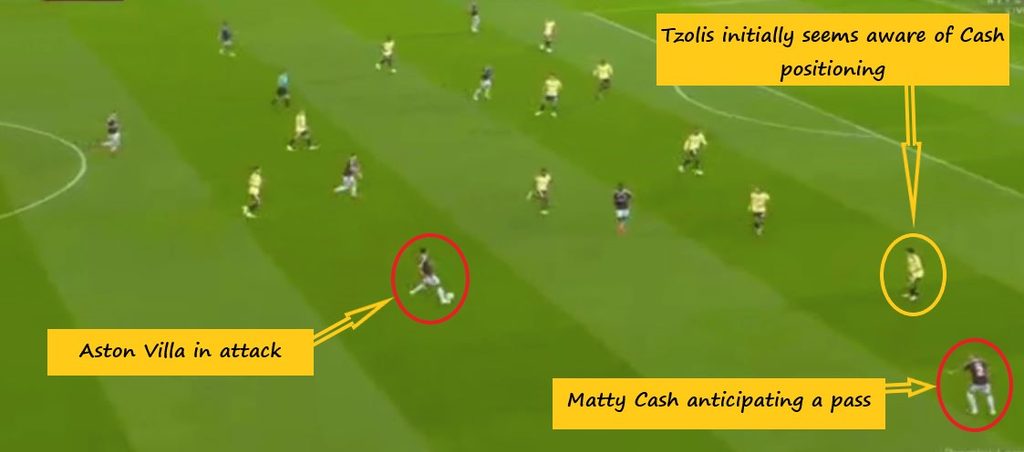
Initially, Tzolis had done the correct thing by dropping back and helping Riccardo Calafiori defend the left side. However, just as Cash began making a run behind Arsenal’s defensive line, Tzolis abandoned his position.
That brief lapse was enough for Cash to move into a dangerous area.
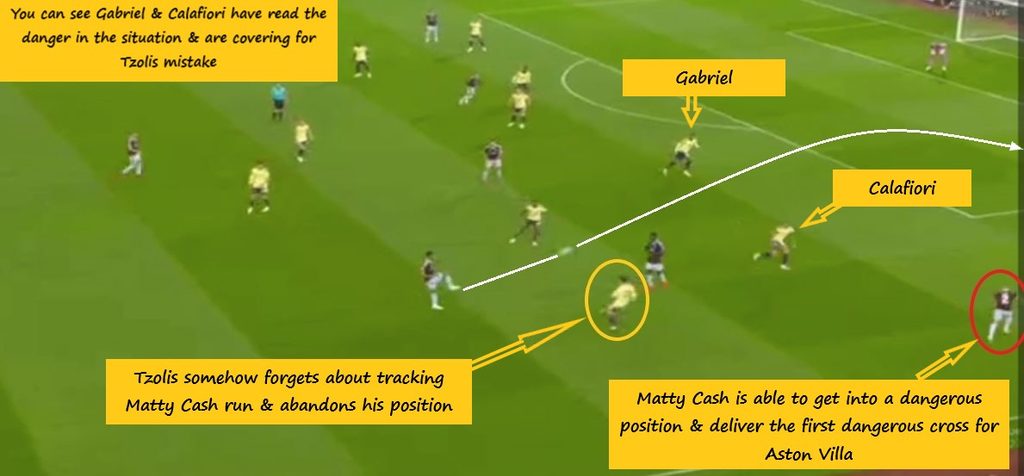
The Aston Villa full-back eventually received the ball in space and was able to deliver a dangerous cross without being properly pressured. Gabriel Magalhães and Calafiori had already recognised the danger and were moving across to deal with it.
The cross found its way into the penalty area and could easily have resulted in an early goal.
Emiliano Buendía came particularly close. The Argentine was in a position to meet Cash’s delivery with a simple touch, and his reaction afterwards showed just how promising the opportunity had been.
This is where the Christos Tzolis performance becomes particularly interesting from a defensive perspective.
The issue was not necessarily a lack of effort. Tzolis had already demonstrated his willingness to track back. The concern was that, having done the hard work of recovering his position, he switched off at precisely the moment when Cash became the most dangerous player on the flank.
Against a team like Aston Villa, those small lapses can have significant consequences.
Arsenal and Aston Villa have produced a number of tight encounters in recent seasons, and this match was another example of how fine the margins can be. Arsenal eventually won 1-0, meaning an early defensive mistake of this nature could easily have changed the entire contest.
Tzolis Struggles in the Physical Battle
The concerns became more pronounced around the 10:58 mark.
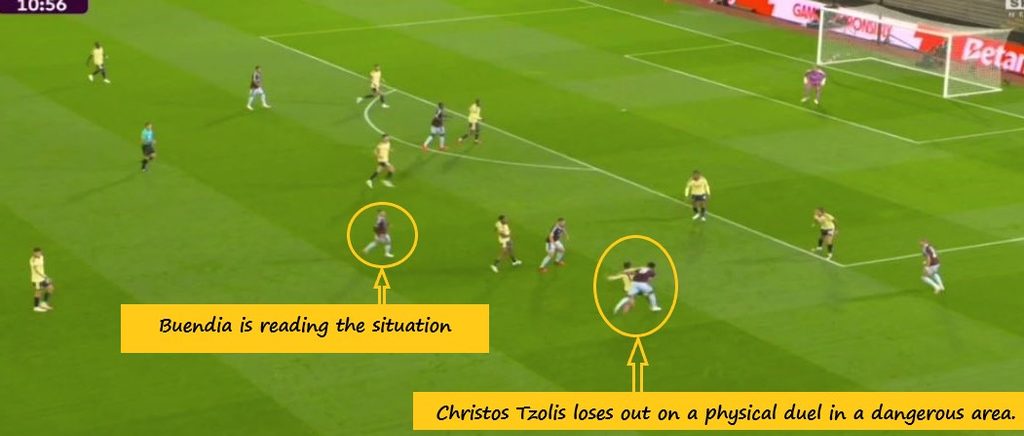
Tzolis lost possession after being involved in a physical duel in a dangerous area, with referee deemed the contact insufficient for a foul.
There is certainly an argument that Boubacar Kamara pulled Tzolis backwards while holding him around the shoulders. That contact appeared to contribute to Tzolis losing his balance and being unable to win the ball back.
But there is another side to the argument.
Whether the challenge should have been given as a foul or not, Premier League football often demands that players continue competing through contact. Tzolis will have to learn how to protect the ball, use his body more effectively and remain competitive when an opponent applies physical pressure.
That was particularly important because of what happened next.
Lewis-Skelly appeared to expect a free-kick, while Buendía reacted immediately, came from behind and collected the loose ball. Aston Villa suddenly had an opportunity to attack before Arsenal could reorganise.
Buendía eventually struck the ball first time.
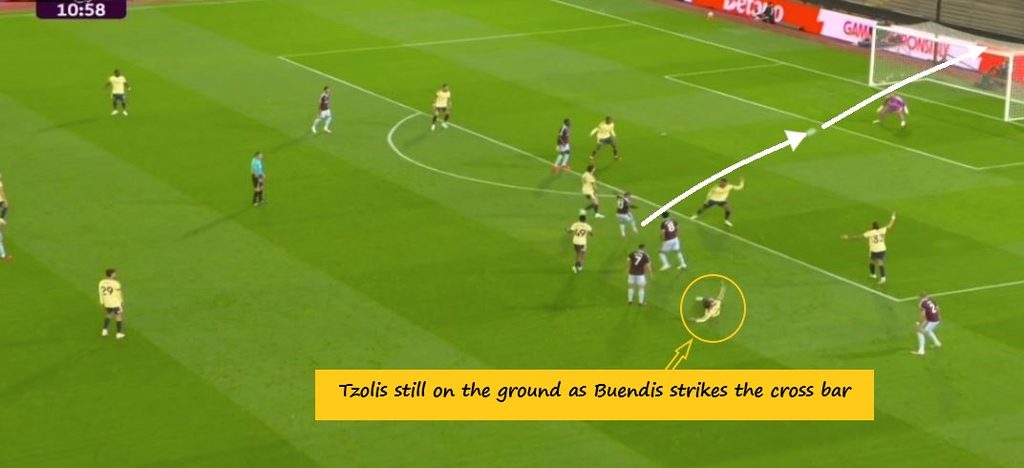
His effort beat David Raya but struck the crossbar.
Once again, Tzolis’ mistake did not result in a goal, but Arsenal were fortunate that it did not.
This is an important distinction when assessing the Christos Tzolis performance. A player can make an error without being punished for it. The absence of a goal does not necessarily mean the decision was harmless.
Arsenal fans will expect Tzolis to become much more difficult to dispossess as he adapts to the league.
Players such as Lewis-Skelly have shown how effectively young footballers can use their bodies to protect possession, absorb contact and win duels. Tzolis will need to develop that same resilience.
Another Physical Duel Tells the Same Story
At around 25:40, another physical battle produced a similar outcome.
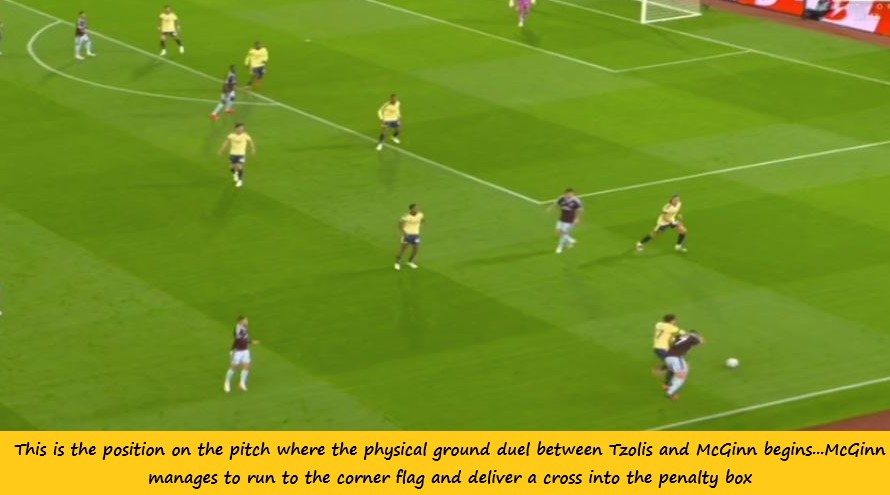
This time, Tzolis struggled against John McGinn.
Tzolis attempted to use his body and arms to disrupt McGinn’s progress, but the Aston Villa midfielder was able to continue his run for a considerable distance before delivering a cross into Arsenal’s penalty area.
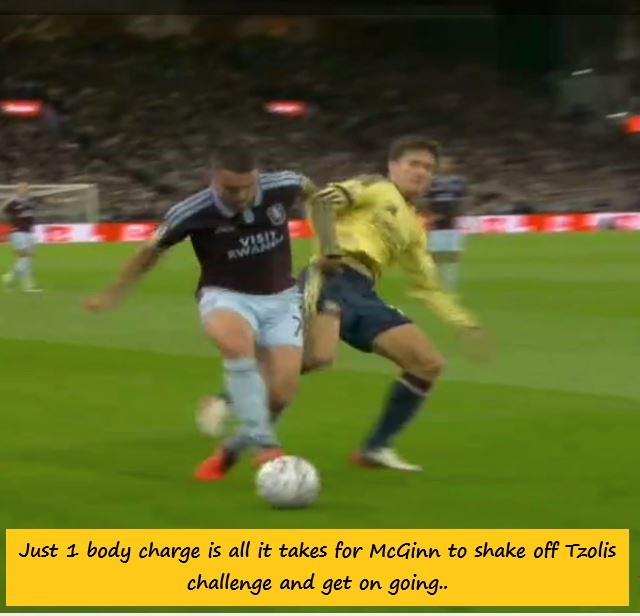
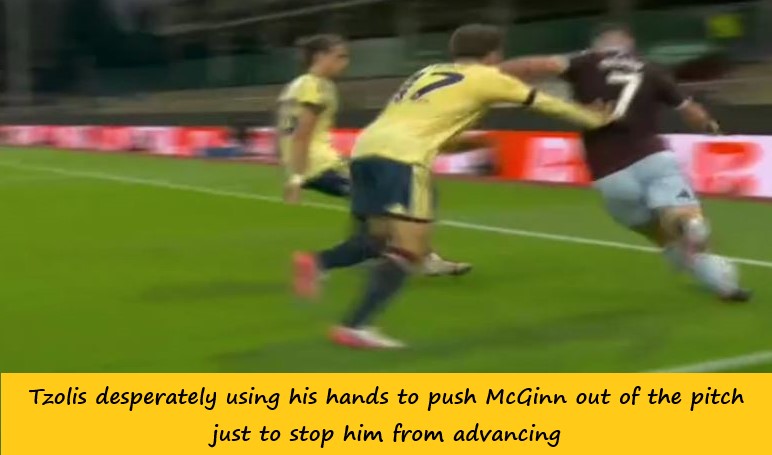
Gabriel Magalhães ultimately dealt with the danger.
Again, the problem was not simply that Tzolis lost one duel. The more concerning pattern was his difficulty imposing himself physically on an Aston Villa side that was willing to challenge him aggressively.
For a winger operating in the Premier League, physical strength is not merely useful. It can determine whether an attacking move continues or breaks down.
Tzolis’ performance at Villa Park suggested that this is one area of his game that still requires considerable adaptation.
Tzolis Did Show the Right Defensive Instinct
It would be unfair, however, to describe the entire Christos Tzolis performance as a failure.
There were moments when he demonstrated exactly the defensive work expected from a modern winger.
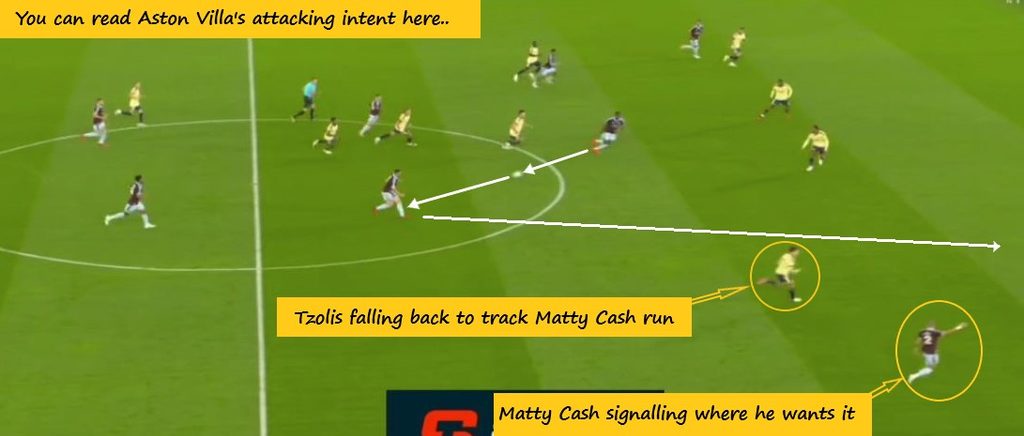
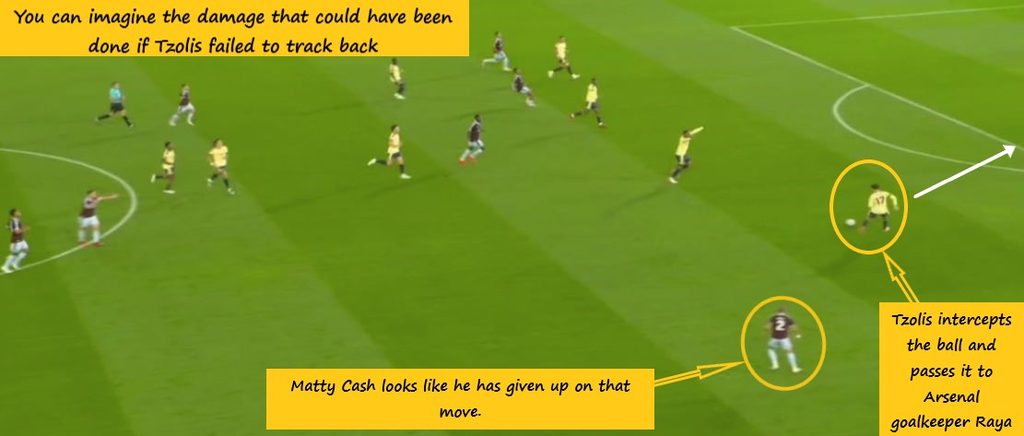
At around 14:11, Tzolis tracked back intelligently to deal with another run from Cash.
He anticipated the Aston Villa full-back’s movement down the right and recovered his position effectively. Cash even raised his hand to indicate that he was already in position and ready to receive the ball.
That moment is important because it shows that Tzolis understands what is required of him without possession. You can almost imagine the damage that could have been caused on Arsenal by Aston Villa if Tzolis failed to track back and intercept the pass as he did.
He was not simply refusing to defend or neglecting his defensive responsibilities.
The issue was consistency.
Only minutes earlier, he had lost concentration when Cash made a dangerous run. Here, he read the situation correctly and positioned himself to prevent the pass from reaching the Villa full-back.
For a player still adapting to Arsenal and the Premier League, that distinction matters. The defensive instincts are there. What Tzolis needs is greater consistency in executing them.
Tzolis Could Not Find His Crossing Rhythm
Tzolis’ attacking contribution was also disappointing.
There were relatively few Arsenal attacks developing down the left during his time on the pitch, but he had an excellent opportunity to produce something around the 16:31 mark.
Tzolis initially did well.
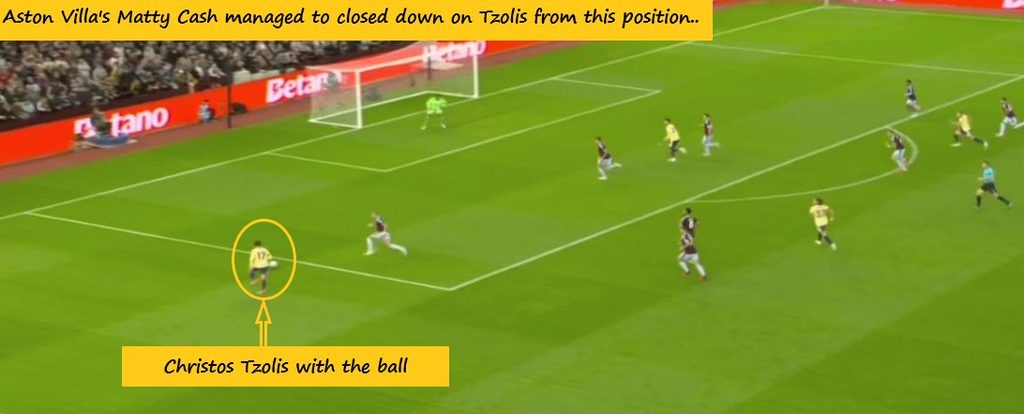
He moved into space on the left and positioned himself to receive the ball from Calafiori. Crucially, he had created a reasonable amount of separation from the nearest Aston Villa defender.
When Calafiori eventually found him, Tzolis appeared to have enough room to deliver a dangerous cross.
But the opportunity disappeared.
His delivery was firmly blocked by Cash.
One possible explanation is that Tzolis took too long to release the ball, giving Cash enough time to close him down. Another possibility is that the attempted cross was simply aimed too close to the defender.
Either way, it was an underwhelming outcome from a promising position.
The same problem appeared again at around 38:59 and 41:26, when Tzolis was once more unable to get a cross through.
That was a significant contrast with his earlier performances.
The Tzolis Arsenal fans had watched against Coventry and Manchester City looked much more decisive in possession. At Villa Park, he appeared slower to make decisions and less capable of creating separation when opportunities presented themselves.
Tzolis’ Dribbling Failed Him Against Aston Villa
The problems continued at around 27:59.
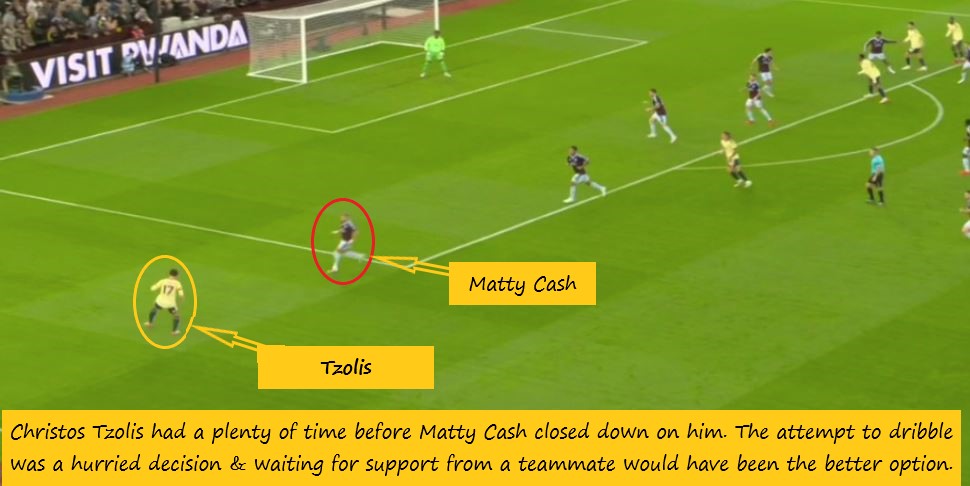
Tzolis received an excellent diagonal pass from Lewis-Skelly on the left wing. The ball was delivered into a particularly favourable situation because Tzolis had a reasonable amount of space between himself and Cash.
He was not under immediate pressure.
This should have been an opportunity to attack.
Instead, Tzolis attempted to dribble past Cash and was stopped almost immediately. Cash won possession, leaving Arsenal vulnerable to a potential counter-attack.
Tzolis then committed a foul on Cash in an attempt to prevent Aston Villa from breaking forward.
The foul resulted in a yellow card before the half-hour mark.
The sequence highlighted two separate problems.
First, Tzolis failed to exploit the space available to him.
Second, his unsuccessful dribble forced him into a recovery challenge that carried disciplinary consequences.
A winger will inevitably lose the ball while attempting to take on defenders. That is part of the position.
But when the player is already struggling to influence the game, repeated failed dribbles can become particularly costly if they also expose the team defensively.
Tzolis Was Lucky to Avoid a Second Yellow Card
The situation became even more dangerous around 35:08.
Tzolis attempted another dribble, this time against McGinn in the middle of the pitch.
Once again, there appeared to be a safer option available.
Tzolis had enough time to recycle possession and pass to a teammate, but instead chose to carry the ball forward. McGinn read the situation, won possession and left Arsenal facing another potential counter-attack.
Tzolis then committed another foul as he attempted to stop McGinn.
The referee played advantage because Aston Villa retained possession.
That decision was particularly important for Tzolis.
Having already received a yellow card, another caution would have resulted in a red card and Arsenal being reduced to 10 men.
Tzolis was therefore fortunate to escape without a second booking.
The bigger issue was the repeated pattern of decision-making.
After losing possession through an unsuccessful dribble at 27:59 and receiving a yellow card while trying to stop the resulting counter, Tzolis attempted something remarkably similar again less than eight minutes later.
This time, the consequences could have been much worse.
Taking risks is part of attacking football, but there is a difference between constructive risk-taking and unnecessarily exposing your team to danger.
On this occasion, Tzolis was taking too much risk.
Arteta Had Seen Enough by Half-Time
By half-time, Mikel Arteta had seen enough and replaced Tzolis with Eberechi Eze.
The substitution was not simply a reflection of Tzolis’ attacking output. His defensive lapses, struggles in physical duels, failed dribbles, unsuccessful crosses and disciplinary risk had combined to produce a very difficult first half.
Eze subsequently brought greater energy to Arsenal’s left side and became involved in the move that produced the decisive goal.
That should not necessarily be interpreted as a verdict on Tzolis’ long-term prospects at Arsenal.
One poor performance does not erase an excellent debut.
But it does raise questions that Tzolis will have to answer quickly.
How Fast Has Tzolis’ Performance Dropped?
This is ultimately the most interesting question surrounding Christos Tzolis performance after Arsenal’s win at Aston Villa.
Only days after his impressive Premier League debut against Coventry, Tzolis looked almost unrecognisable.
The contrast was not limited to his attacking numbers. His confidence on the ball appeared lower, his dribbling was less effective, his crossing lacked precision, his physical duels were difficult, and there was a worrying lapse in concentration when tracking Cash.
At the same time, it would be premature to draw sweeping conclusions about the player.
Tzolis is still adapting to English football, Arsenal’s tactical demands and the physical intensity of the Premier League. Fatigue could also be playing a role given how quickly he has been introduced into competitive action.
There is therefore a reasonable argument that Arsenal fans should be patient.
But patience should not mean ignoring what happened at Villa Park.
The Christos Tzolis performance against Aston Villa was a major step backwards from what he produced against Coventry and Manchester City. The encouraging part is that the problems are identifiable: physical resilience, decision-making, defensive concentration, crossing under pressure and knowing when to dribble and when to recycle possession.
Those are all areas that can improve.
The Aston Villa match should therefore be viewed less as a verdict on Tzolis and more as his first serious reminder of just how demanding the Premier League can be.
His debut suggested that Arsenal may have acquired an exciting attacking talent.
His performance at Villa Park showed that talent alone will not be enough.
Tzolis now has to demonstrate that he can reproduce his best level consistently — not just when everything is going his way, but when opponents are stronger, more aggressive and determined to take away his space.
That will be the real test of his adaptation to Arsenal.
Conclusion
The Christos Tzolis performance against Aston Villa was a significant reality check after the optimism generated by his impressive Arsenal debut against Coventry. At Villa Park, the winger struggled with the physicality of the game, made costly decisions in possession, failed to create enough from the left and showed lapses in concentration that could easily have punished Arsenal.
However, one poor performance should not overshadow what Tzolis had already demonstrated in his first appearances for Arsenal. The talent is clearly there, but adapting to the Premier League requires consistency, especially when opponents deny space and make every duel a physical battle.
For Tzolis, the challenge now is to respond. His next few appearances will be important in determining whether the Aston Villa game was simply an early setback or the beginning of a more concerning dip in form. Arsenal do not need him to be perfect, but they will need the confident, decisive and aggressive winger they saw against Coventry to return quickly.
Leave a Reply