
Manchester United’s 5–2 victory over Ipswich Town at Old Trafford will inevitably be remembered for Bruno Fernandes’ hat-trick, the captain’s four-goal contribution through three goals and an assist, and a second-half performance that eventually overwhelmed Gary O’Neil’s side.
But there was another performance that deserves much closer examination.
Kobbie Mainoo.
Fernandes was unquestionably the headline act. His goals changed the game, and his quality in the final third ultimately made the difference. Yet if the question is which Manchester United player most effectively addressed the team’s biggest problem during the game, Mainoo has a compelling claim.
That problem was ball progression.
Manchester United struggled for long periods to move the ball from defence into attack with enough control, precision and purpose. Their passes were sometimes too slow, sometimes too ambitious and, on other occasions, simply played at the wrong speed for the player receiving them. Ipswich, meanwhile, repeatedly demonstrated how quickly a team can progress the ball without resorting to hopeful long passes.
The difference was particularly obvious during the first half.
Ipswich were able to move through United’s defensive structure with greater fluidity, while United frequently found themselves attacking against an already-set defensive block. Even when Manchester United did manage to break forward, the final pass or the speed of the attack often worked against them.
And this is where Mainoo stood out.
He did something Manchester United were struggling to do consistently: he carried the ball through pressure, resisted challenges, connected play with simple combinations and then released the ball at the right moment.
That quality helped change the game.
Michael Carrick himself recognised Mainoo’s contribution afterwards, describing the midfielder as “immense” and praising his all-round performance.
Manchester United vs Ipswich: A First Half That Exposed United’s Ball-Progression Problem
The final scoreline makes Manchester United’s afternoon look considerably more comfortable than it actually was.
Ipswich were the more convincing side for significant stretches of the first half. They threatened Senne Lammens repeatedly, forced Manchester United into uncomfortable defensive situations and, before the interval, had created enough opportunities to suggest that United could easily have gone into half-time behind by more than one goal.
Indeed, the atmosphere inside Old Trafford told part of the story. Ipswich supporters were making themselves heard despite being the minority, particularly when their team had established control of the game.
The statistics also reflected the competitiveness of the opening period. By around the 42nd minute, Ipswich had registered four shots on target compared with United’s three.
The visitors’ opener came in the 29th minute after Abdul Fatawu beat Luke Shaw for pace and delivered for Leif Davis to finish. United’s response did not come from a sustained period of controlled possession, either. It came after Marcelino Núñez slipped, allowing Matheus Cunha to recover the ball before finding Fernandes, who finished to level the match shortly before half-time.
That distinction matters.
Manchester United had found a way back into the game, but they had not yet solved the underlying problem.
4:22 — Martinez Struggles to Progress the Ball
At around 4:22, the problem becomes particularly clear.
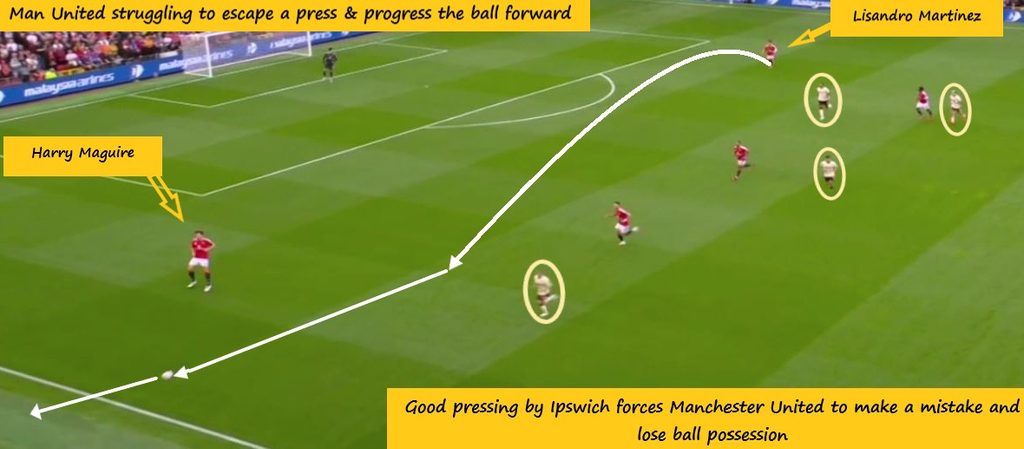
Lisandro Martínez receives the ball under pressure after Luke Shaw, having received possession from Youri Tielemans, opts to recycle the ball backwards rather than force the play forward.
Martínez then attempts to switch the point of attack towards Harry Maguire, who is positioned on the right side and attempting to open his body to receive the pass.
But the switch is inaccurate and runs out of play.
One isolated misplaced pass means little. The significance comes from the pattern.
Ipswich were pressing intelligently enough to force United backwards, while United were struggling to find reliable ways of escaping that pressure and transferring possession from one side of the pitch to the other.
In this case, the problem was not simply that Manchester United were making mistakes.
The problem was that Ipswich were making those mistakes necessary.
5:37 — The Long Ball Is Read by Ipswich
A little later, Martínez attempts another solution, this time looking for Marcus Rashford with a lofted pass.
Ipswich read it well and intercept.
Once again, the issue is not merely that a pass failed. The pass allowed Ipswich to defend the situation comfortably because the ball travelled through an area they were already prepared to protect.
Manchester United were therefore faced with the same problem repeatedly: get the ball forward quickly and risk losing it, or circulate possession more cautiously and allow Ipswich to reorganise.
Ipswich were particularly effective at the latter.
Whenever United appeared to be building momentum, the visitors could retreat into their defensive structure and remove the spaces Manchester United wanted to attack.
6:29 — Cunha Shows United What Ball Carrying Can Do
At 6:29, however, Manchester United produce a much better sequence.
The move begins with Martínez, who finds Matheus Cunha around the middle third.
Cunha receives the ball under pressure and does something United desperately needed more of: he carries it through pressure rather than immediately passing around it.
He beats two Ipswich players before releasing Rashford on the left. The pass is particularly effective because it removes three Ipswich players from the immediate defensive picture and gives Rashford space to attack.
Rashford drives down the left, enters the penalty area and searches for an opening.
But Ipswich have already recovered their defensive shape.
The window has closed.
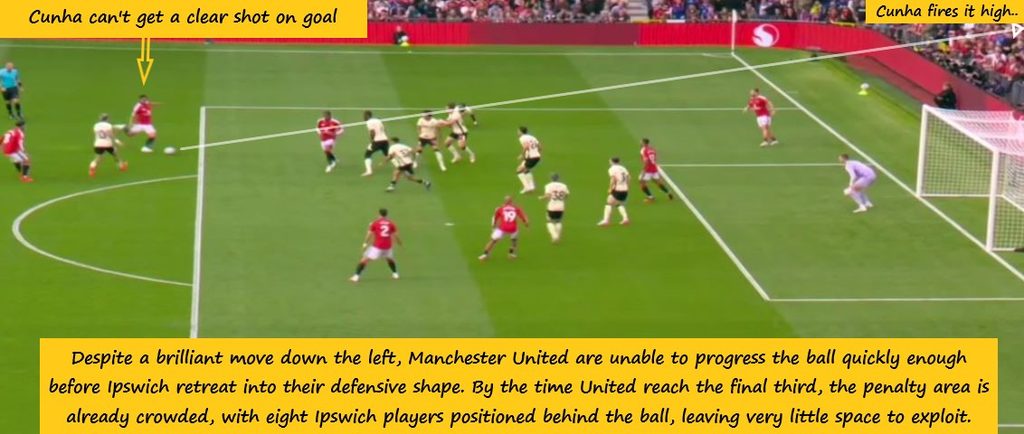
Rashford is therefore forced to recycle possession back towards Cunha, who attempts a shot through a crowded penalty area that eventually sails over the crossbar.
This sequence encapsulates Manchester United’s first-half problem.
They could sometimes create the first advantage. What they struggled to do was sustain that advantage before the opponent recovered its shape.
Ipswich Were Progressing the Ball With Greater Speed and Purpose
At around 7:22, Ipswich demonstrate the contrast.
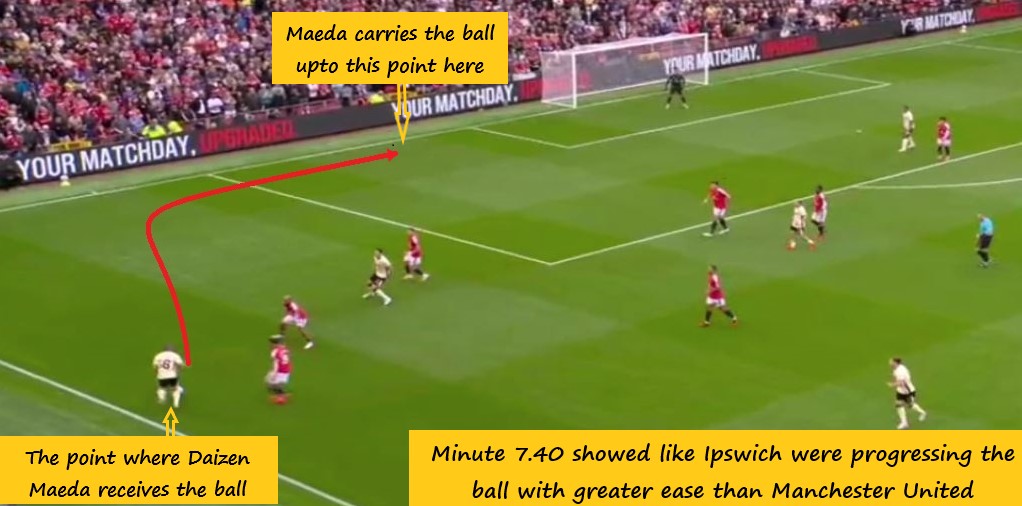
Daizen Maeda receives the ball on the left and drives towards the Manchester United penalty area, eventually forcing Lammens into a save at the near post.
The important point is not simply that Maeda got a shot away.
It is how quickly Ipswich transformed possession into a threat.
The visitors were not spending several seconds searching for the perfect long pass. They were using movement, short combinations and the pace of their wide players to move the ball into dangerous areas before Manchester United could establish control.
That pattern would appear repeatedly.
At 8:06, Manchester United attempt to respond.
Tielemans, positioned relatively deep, quickly finds Bryan Mbeumo on the right. Mbeumo then looks for Cunha, who is attempting to run beyond the Ipswich defensive line.
The idea is correct.
The execution is not.
Cunha receives the ball while travelling at high speed and cannot keep it inside the field. The ball runs out for an Ipswich goal kick.
This is an important distinction.
Speed is not the same thing as progression.
A team can move the ball quickly and still make no meaningful progress if the pass is played faster than the receiver can control it.
Football is ultimately a relationship between the speed of the ball and the speed of the player.
If the ball consistently arrives faster than the player can process and control it, the attack becomes disconnected. It is like a dancer moving out of rhythm with the music: there is movement, but there is no coordination.
Manchester United occasionally had too much of that kind of speed.
Bruno Fernandes’ Ambitious Passing Was Not Always the Solution
At 11:14, Bruno Fernandes attempts one of his trademark forward passes towards Mbeumo on the right.
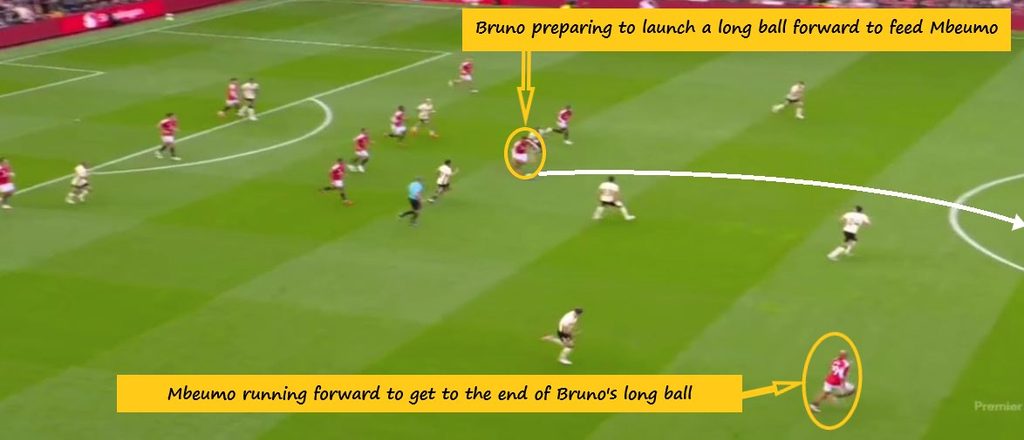
At first glance, the move looks promising.
United appear to be attacking an Ipswich defence that has been caught with players ahead of the ball. Fernandes spots Mbeumo and tries to exploit the space.
But by the time Mbeumo reaches the ball, Ipswich have already recovered their defensive positions.
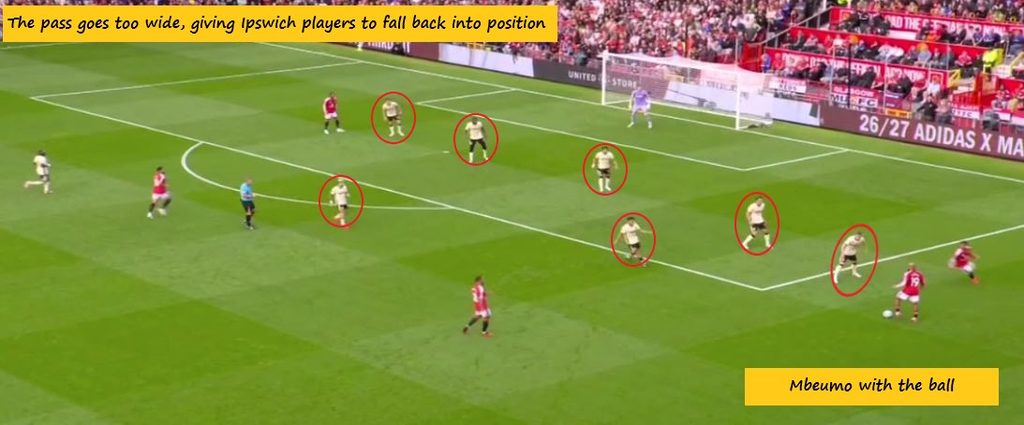
Part of the problem is the weight of the pass.
Fernandes has overhit it, forcing Mbeumo to spend valuable time getting the ball under control rather than immediately attacking the space ahead of him.
That delay is crucial.
By the time Mbeumo can turn towards the penalty area, Ipswich have rebuilt their defensive block.
United eventually work the ball towards Dalot, who fires over the crossbar.
Again, Manchester United have reached the final third without truly penetrating it.
This is why ball progression cannot simply mean playing forward.
The objective is to move the ball forward while preserving the attacking advantage created by the previous action.
If the pass is too slow, the defence closes the space.
If the pass is too fast, the receiver loses control.
If the pass is too predictable, the defender reads it.
The best progressive football combines all three elements: timing, weight and movement.
Manchester United were not consistently achieving that in the opening half.
Ipswich Show United How a Counter-Attack Should Be Played
At 12:46, Ipswich provide perhaps the clearest demonstration of the difference.
United have taken a corner. The ball is cleared and falls towards Julio Enciso.
Enciso appears to be behind the Manchester United defenders, yet he accelerates beyond them and creates a one-on-one situation with Lammens.
The goalkeeper produces an excellent save.
But the important part is the transition itself.
Ipswich turn a Manchester United set piece into a dangerous attacking opportunity almost immediately.
There is no unnecessary hesitation.
There is no hopeful ball launched without a clear target.
There is simply recognition of space, acceleration into it and a forward action executed at the right speed.
At that stage of the match, Ipswich were arguably showing a greater capacity than United to transform possession into territory and territory into danger.
Manchester United’s Best Chance Came Against the Run of Play
At 13:08, Manchester United finally create a significant opportunity of their own.
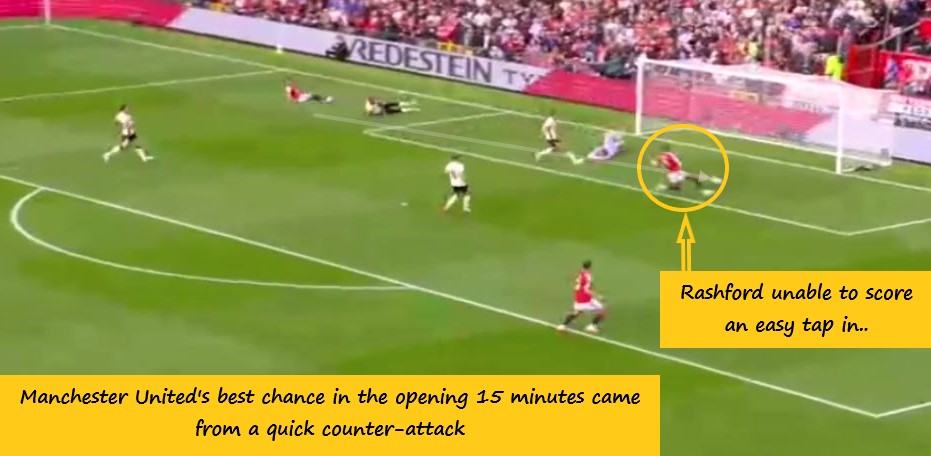
But even this chance needs to be placed in context.
United catch Ipswich in an advanced position immediately after Enciso’s attempt at the other end. The opportunity therefore comes from exploiting the space left by Ipswich while they themselves are attacking.
That is the essence of a counter-attack.
Manchester United should have made more of the chance, but it is important not to confuse the opportunity with evidence that United had solved their attacking problem.
They had not.
In fact, it was another example of the same theme: United were more dangerous when the opposition was disorganised than when they had to systematically dismantle an organised defensive block.
There was another warning sign at 8:06, when Cunha had previously run the ball out of play because the delivery arrived too quickly.
United were not merely lacking speed.
They were lacking controlled speed.
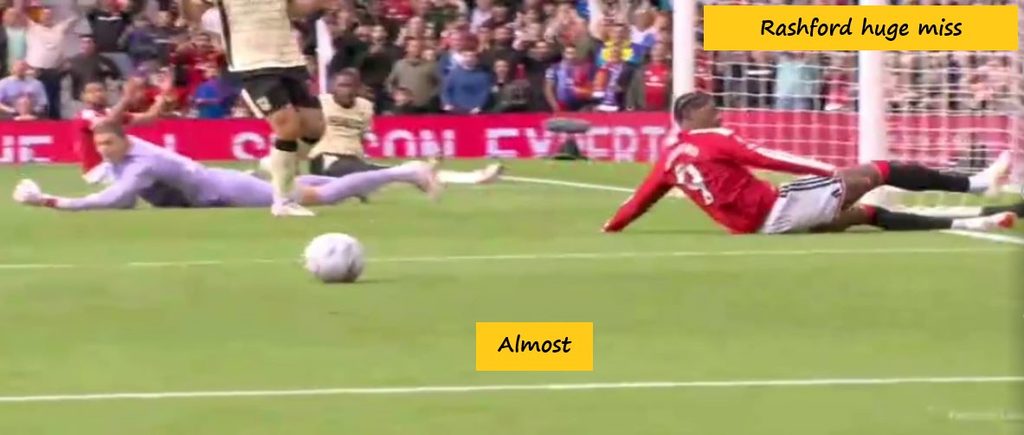
That distinction becomes increasingly important when analysing the performance.
17:01 — A Passing Error Highlights the Problem
At 17:01, Youri Tielemans attempts to find Mainoo in midfield, but an Ipswich player intercepts.
This is particularly notable because Tielemans is one of the players United brought into the midfield partly for his ability to dictate play through passing.
The issue here is not that Tielemans cannot pass.
It is that midfield passing requires constant awareness of pressure, positioning and the opponent’s defensive intentions.
A pass into a midfielder who is being monitored can become dangerous if the passer does not recognise the defender’s position.
Had the ball not fallen kindly for Harry Maguire afterwards, the turnover could have developed into a much more dangerous Ipswich attack.
It was another example of Manchester United making their own progression unnecessarily difficult.
And then Mainoo began showing a different solution.
Kobbie Mainoo Was Different
At 17:58, Kobbie Mainoo wins possession in midfield through sheer physicality.
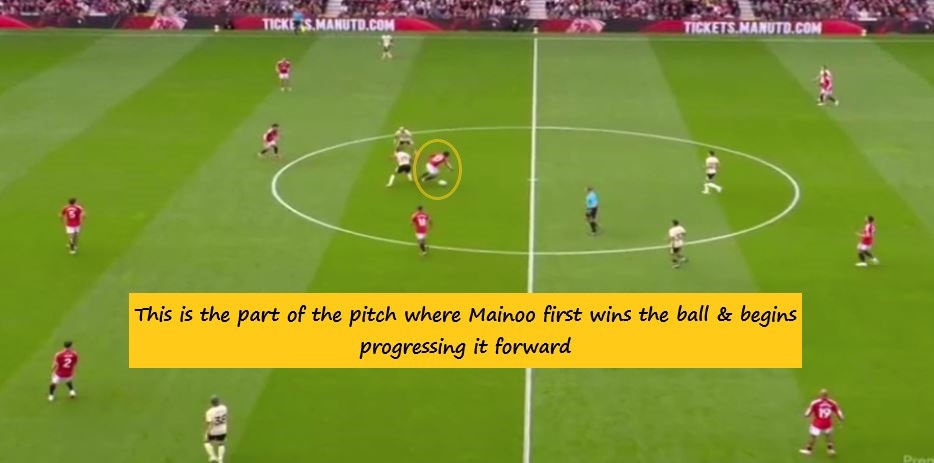
He does not simply recover the ball and immediately play it backwards.
He turns.
He carries.
He advances.
And then, after connecting with a teammate through a simple one-touch combination, Manchester United move into a more advanced area.
That sequence captures what Mainoo brought to the game.
He could physically transport the ball through the first line of pressure.
That is an enormously valuable quality against a team that wants to compress the pitch.
A midfielder who receives under pressure and immediately passes backwards can help maintain possession, but he does not necessarily change the geometry of the game.
A midfielder who receives under pressure, turns and carries the ball beyond one or two opponents forces the opposition to react.
Defenders have to step out.
Midfielders have to retreat.
Passing lanes appear.
Space opens elsewhere.
That is what progressive ball carrying can do.
Mainoo then carries the ball a considerable distance and, even while being challenged and eventually brought down, remains determined to release it to a teammate.
His physical strength and balance were allowing him to resist the kind of pressure that had caused problems for United elsewhere.
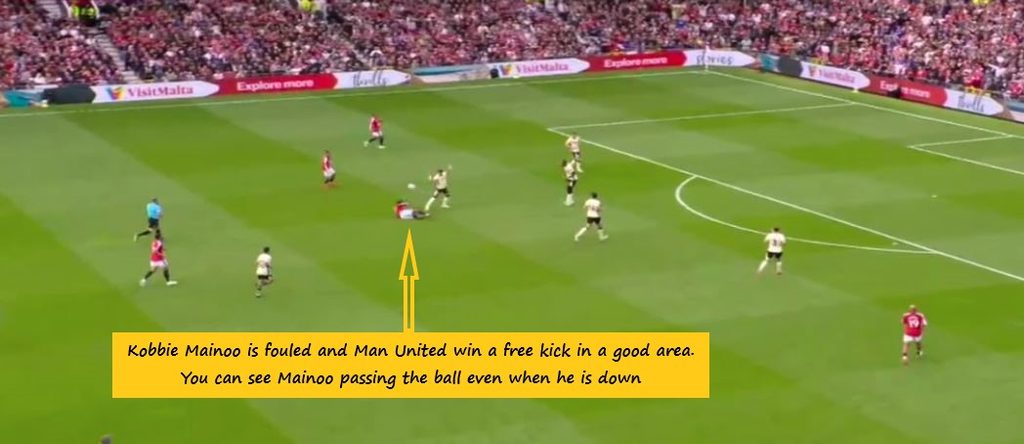
The resulting foul gave Manchester United a dangerous free-kick, although Rashford was unable to trouble the goalkeeper.
The broader point, however, was already clear.
Mainoo was progressing Manchester United’s attack without relying on a speculative long pass.
That was precisely what United had been missing.
Ipswich Continue to Find Gaps in Manchester United’s Defence
At 21:51, Ipswich produce another sequence that deserves attention.
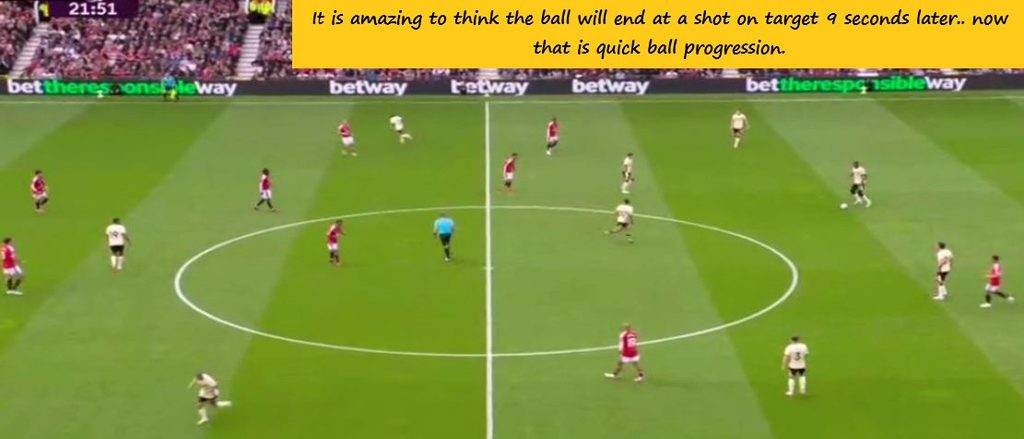
An Ipswich central defender receives possession deep in his own half.
Nine seconds later, Lammens is making a save at the other end.
That is the kind of sequence Manchester United should study carefully.
Ipswich did not need to launch a long ball.
They did not need to bypass their midfield.
They moved the ball systematically through a series of passes and movements involving several players before finding Maeda on the left.
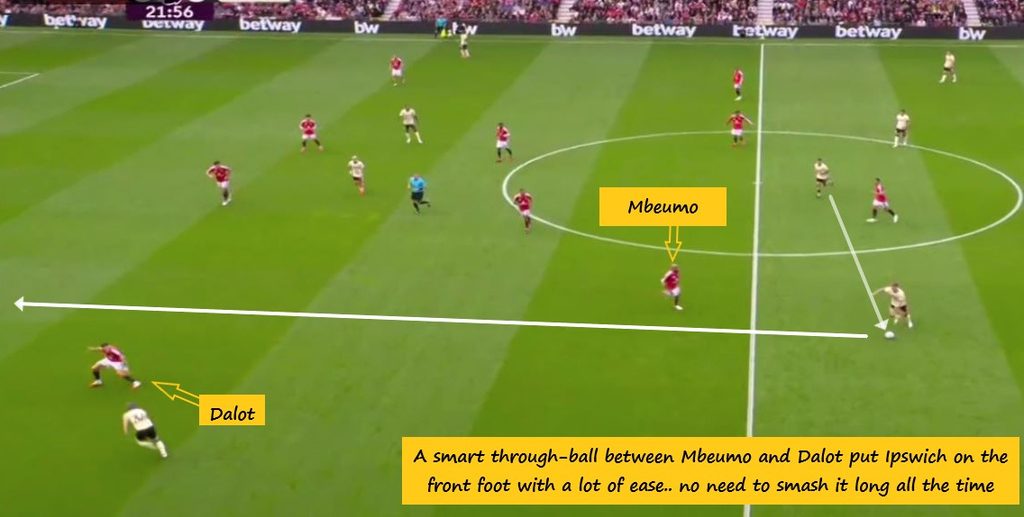
The through ball is particularly important.
Maeda’s pace allows him to run beyond Dalot and carry the ball towards the Manchester United penalty area before forcing Lammens into action.
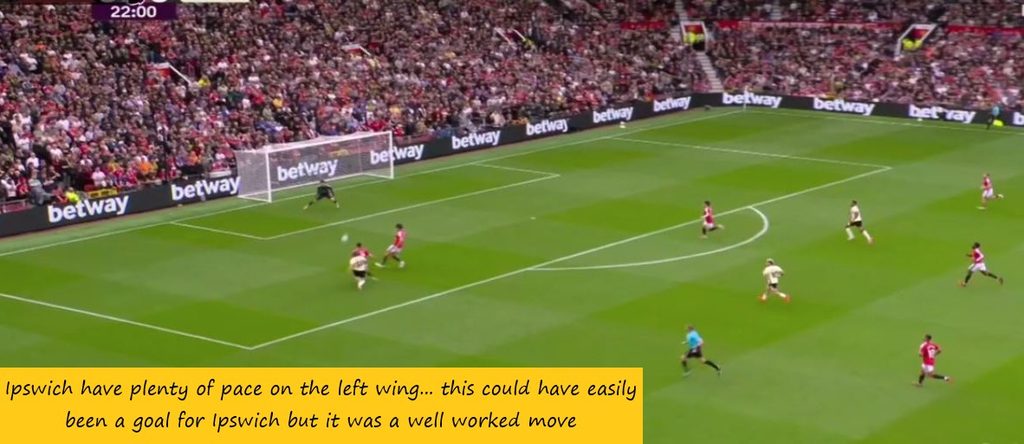
This is what effective ball progression looks like.
Progression does not always mean a spectacular pass.
Sometimes it is simply a sequence of technically secure actions, each one moving the opponent slightly out of position until a runner can attack the space that has been created.
Ipswich were doing this with impressive regularity.
Ipswich Had Speed on Both Wings
At around the 28th minute, Ipswich demonstrate that their threat was not confined to the left.
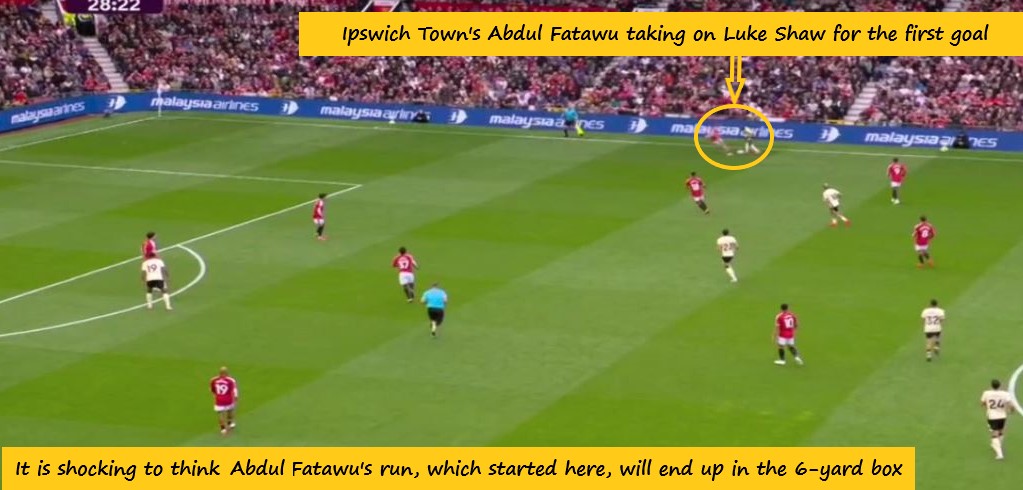
Abdul Fatawu receives the ball on the right, accelerates past Luke Shaw and carries possession a considerable distance before reaching the Manchester United penalty area.
His run ultimately contributes to Ipswich’s opening goal, with Fatawu’s penetration creating the conditions for Leif Davis to finish.
Look at the distance Fatawu covers between receiving the ball and releasing it.
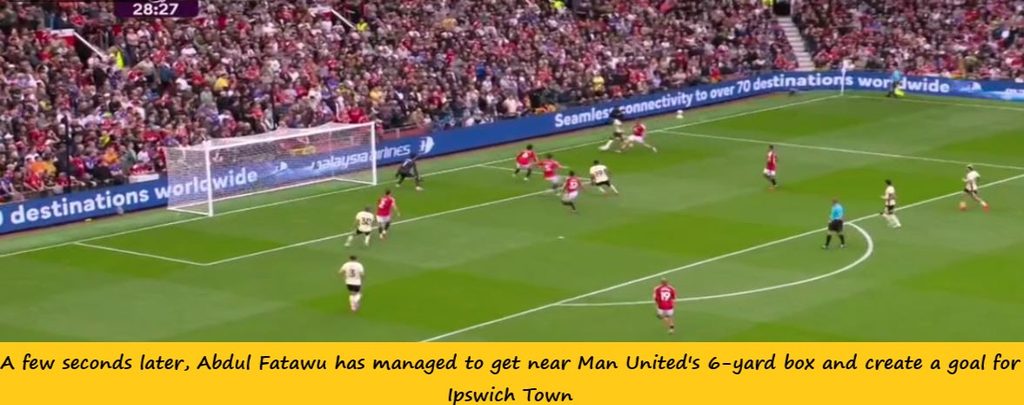
That is an important part of Ipswich’s attacking identity in this game.
They were not simply passing the ball towards Manchester United’s penalty area.
They were carrying it there.
The same pattern appears again around 30:14.
Ipswich combine through a series of intelligent passes and movements, moving the ball from their own defensive area into the Manchester United penalty area in roughly 21 seconds.
The sequence ends with Lammens producing another save, this time from O’Shea.
The significance is not the exact number of seconds.
It is the manner of progression.
Ipswich could advance the ball through combinations and movement without immediately resorting to a long ball.
Manchester United, by contrast, were often trying to solve the same problem with either long passes, crosses or individual moments of counter-attacking quality.
Manchester United’s Equaliser Came From an Ipswich Mistake
By 39:44, Manchester United had still not produced many sustained sequences of possession that consistently threatened Ipswich through controlled build-up.
Much of United’s danger had come through transitions.
Then Ipswich made the mistake that changed the game.
Marcelino Núñez slipped, allowing Cunha to recover possession and find Fernandes, who finished the equaliser.
There is an important distinction to make here.
Manchester United deserve credit for recognising the opportunity and punishing the mistake.
But the goal itself does not necessarily demonstrate that United had solved their structural attacking problem.
It was a transition created by an opponent’s error.
Ipswich had committed players forward, lost possession in a dangerous area and left space behind them.
United exploited it.
That is good attacking awareness.
But it is different from systematically progressing the ball from defence to attack against a settled opponent.
That distinction is central to this analysis.
Manchester United went into half-time level, but Ipswich had arguably been the better side for much of the opening period.
The Second Half Changed the Game
The opening stages of the second half continued to expose some of the same issues.
By around the 50th minute, Ipswich were still capable of closing United down and preventing them from progressing comfortably through central areas.
Manchester United, however, began to exert greater pressure.
And one of their most useful attacking weapons was something they had already shown in the first half:
crossing.
Manchester United Were a Threat From Crosses
Around 51:59, Manchester United come close to scoring from a crossing situation.
This was significant because United had struggled to consistently penetrate Ipswich through central combinations.
When the central route became congested, the wide areas offered an alternative.
Crosses allowed United to bypass some of the pressure in midfield and attack the penalty area directly.
That does not necessarily mean crossing is a bad strategy.
The problem arises when crossing becomes the default solution because a team cannot progress through the centre.
Against Ipswich, Manchester United were increasingly pinning the visitors back, and that made crosses more dangerous because more players were occupying advanced positions.
Harry Maguire’s Shot Turns Into Another United Goal
At around 53:08, United were increasingly resorting to attempts from outside the penalty area.
Tielemans tried his luck from distance, but the shot went straight towards the Ipswich goalkeeper.
Then, at 55:56, a similar approach produced a goal.
Harry Maguire’s shot was deflected into the Ipswich net by Jacob Greaves.
The goal was officially credited as an own goal to Greaves after VAR ruled that Maguire’s accidental handball did not invalidate the goal under the applicable rules.
Again, there is a tactical point worth making.
Manchester United had crowded Ipswich into their own penalty area and were repeatedly attempting to find a route through a mass of defenders.
The shot took a deflection and ended in the net.
United had found a breakthrough, but the route was hardly a repeatable attacking pattern.
They had effectively created a siege around the Ipswich box and were testing whether something would fall their way.
On this occasion, it did.
Kobbie Mainoo Made the Difference
Then came the sequence that, for me, best explains why Mainoo deserves far more attention than his relatively quiet statistical output might suggest.
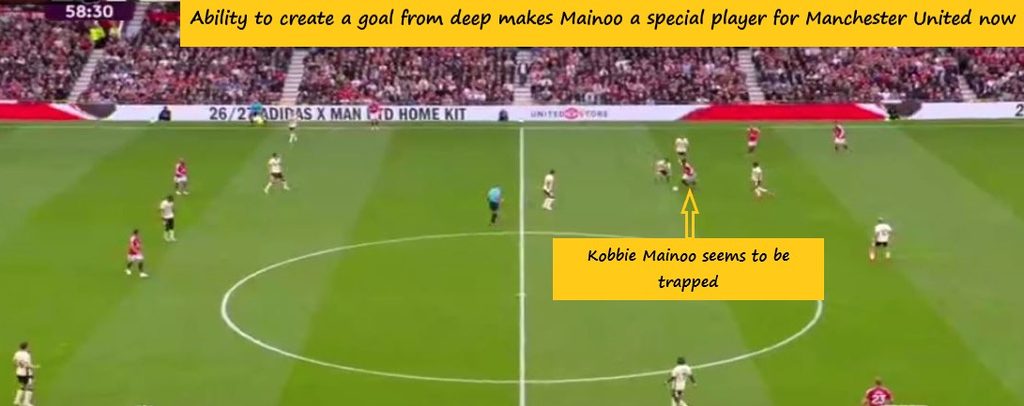
Around the 58th minute, Mainoo receives possession under pressure with multiple Ipswich players around him.
This is exactly the kind of situation in which Manchester United had struggled earlier.
But Mainoo does not panic.
He escapes the pressure.
He carries the ball forward.
And then he plays a perfectly weighted pass into Matheus Cunha’s path.
The pass is not merely accurate.
It is timed to preserve Cunha’s advantage.
Cunha is already inside the penalty area when the ball reaches him, and Ipswich are forced into a desperate defensive response.
Cunha is brought down.
Penalty.
Fernandes converts.
3–1.
The official match timeline records the penalty at 58 minutes and Fernandes’ conversion at 61.
This is where Mainoo’s contribution becomes particularly important.
It is easy to look at the scoreboard and say:
Bruno Fernandes scored the penalty.
Correct.
It is also easy to say:
Cunha won the penalty.
Also correct.
But the move only becomes possible because Mainoo breaks the pressure and then delivers the pass with the correct weight and timing.
That is progressive midfield play.
And that is the quality Manchester United had been lacking.
Why Mainoo’s Ball Carrying Matters
The most important quality Mainoo demonstrated against Ipswich was not simply passing accuracy.
It was his ability to change the location of the game with the ball at his feet.
That sounds simple, but it is one of the most valuable qualities a midfielder can possess.
If a midfielder receives the ball and immediately passes backwards, the opposition retains its shape.
If the midfielder carries the ball beyond a pressing opponent, the opposition must adjust.
That creates a chain reaction.
One midfielder steps forward.
Another player drops.
A centre-back becomes uncertain about whether to follow the runner.
A winger finds space.
A forward can attack the channel.
Suddenly, one successful carry has changed the entire attacking picture.
This is exactly what Mainoo repeatedly offered Manchester United.
He could receive under pressure, absorb contact, turn, carry and then connect with a teammate.
That combination of press resistance, ball carrying and progressive passing is different from simply hitting a long ball forward.
It is also much more sustainable against organised opposition.
Manchester United vs Ipswich: The Bigger Tactical Lesson
The 5–2 scoreline should not obscure what the first hour of Manchester United vs Ipswich revealed.
United have attacking quality.
That is obvious.
Fernandes can decide matches.
Cunha can carry the ball through pressure.
Rashford can threaten space from the left.
Mbeumo can attack from the right.
And the team can generate danger from crosses, transitions and shots around the edge of the penalty area.
But the question is whether United can consistently manufacture those opportunities against a team that refuses to make mistakes.
That is where the concern lies.
Against Ipswich, Manchester United frequently looked more dangerous when the game became chaotic.
When Ipswich were attacking, United could counter.
When Ipswich made mistakes, United could punish them.
When the visitors retreated, United could cross.
When the penalty area became crowded, United could shoot from distance.
Those are all legitimate attacking methods.
But they do not necessarily provide a repeatable mechanism for breaking down a well-organised defensive block.
A team competing at the highest level needs more than moments.
It needs a mechanism.
And that mechanism should include controlled ball progression from the first phase into the final third.
The Difference Between Playing Fast and Playing Well
This is perhaps the most important lesson from the game.
Manchester United need to play faster.
But they do not necessarily need to play the ball faster.
Those are two different things.
The first means making decisions quickly.
The second can simply mean hitting the ball harder.
The best teams combine speed of thought with precision of execution.
A midfielder sees the run early.
A defender recognises the passing lane.
A winger starts moving before receiving the ball.
The pass arrives at the exact moment the runner can exploit it.
The receiver does not have to slow down.
The opponent does not have time to recover.
That is genuine attacking speed.
Manchester United occasionally confused this with simply playing the ball forward as quickly as possible.
The 8:06 Cunha sequence was one example.
The 11:14 Fernandes pass towards Mbeumo was another.
Both were intended to accelerate the attack.
But the ball either travelled too quickly or arrived too late relative to the developing situation.
Mainoo offered a different model.
His carries slowed the game down when necessary and accelerated it when the opportunity appeared.
That is why his contribution was so valuable.
Fernandes Was the Star — But Mainoo Was the Midfield Catalyst
None of this is intended to diminish Bruno Fernandes’ performance.
Far from it.
The captain scored three times, including the equaliser and the penalty that put United 3–1 ahead, before completing his hat-trick in the 68th minute. He also provided the assist for Mbeumo’s 82nd-minute goal.
Fernandes was the decisive player.
But being decisive is not necessarily the same as being the player who solved the team’s structural problem.
Mainoo’s influence was different.
He helped United move through pressure.
He carried possession into areas where the team could attack.
He connected midfield to the attacking players.
And most importantly, he provided a way of progressing the ball without relying on speculative long passes.
That is why Mainoo’s performance deserves to be viewed alongside Fernandes’ hat-trick rather than beneath it.
Carrick’s own assessment supports that interpretation. The United manager acknowledged that Fernandes would naturally receive the majority of the praise but singled out Mainoo as “immense” in the middle of the pitch.
What Manchester United Still Need to Improve
Manchester United’s 5–2 victory was emphatic, but the first 60 minutes exposed several areas that still require improvement.
The most important is controlled progression.
United need to become better at moving the ball from their defensive third into the final third without depending on:
- hopeful long passes;
- opposition mistakes;
- chaotic transitions;
- repeated crosses;
- speculative shots from distance; or
- individual moments of brilliance.
Those methods can win matches.
But they cannot be the entire attacking structure.
The best version of Manchester United will be one that can do all of those things and systematically dismantle an organised defensive block.
That requires midfielders who can receive under pressure, turn, carry, combine and play through lines.
Against Ipswich, Mainoo showed why he may be particularly important to that process.
Conclusion: Kobbie Mainoo May Have Given Manchester United What They Were Missing
Manchester United’s 5–2 victory over Ipswich was undoubtedly a statement result after the disappointing opening-day defeat to Hull City.
Bruno Fernandes produced the headline performance.
The captain’s hat-trick gave United control of a match that had threatened to become uncomfortable, while Mbeumo’s late goal completed a comprehensive scoreline. United eventually produced five goals and their first Premier League victory of the season.
But the match also exposed a problem that five goals can easily conceal.
Manchester United still need to become better at progressing the ball against an organised defence.
For much of the first half, Ipswich were able to press United, force them backwards and then recover their defensive shape whenever United attempted to attack.
Long passes were often ineffective.
Some forward passes were overhit.
Counter-attacks occasionally moved faster than the intended receiver could control.
Crosses became an important outlet.
Shots from outside the box became another route to goal.
And some of United’s biggest moments came because Ipswich made mistakes.
Then Mainoo began doing something different.
He received under pressure.
He turned.
He carried.
He resisted challenges.
He combined with teammates.
And when the opportunity appeared, he played the pass that moved the attack beyond Ipswich’s defensive line.
That is not simply possession.
That is progression.
And progression is precisely what Manchester United were missing for large portions of this match.
The irony is that United have invested heavily in reshaping their midfield, yet the player who appeared most capable of changing the rhythm and geography of the game against Ipswich was the academy graduate already inside the squad.
Andrey Santos and Youri Tielemans may have important roles to play. Fernandes remains the team’s creative and goalscoring reference point.
But if Manchester United want to build an attacking structure that works not only against teams that make mistakes, but also against opponents who defend compactly and recover their shape quickly, Kobbie Mainoo’s ability to carry the ball through pressure could become one of Michael Carrick’s most important tactical weapons.
Bruno Fernandes won Manchester United the headlines.
Kobbie Mainoo may have shown them the solution.
Leave a Reply