

Arsenal began their 2026/27 Premier League season with a comfortable 3-0 victory over Coventry City at the Emirates, but for many Arsenal fans, Christos Tzolis’ Arsenal debut was one of the biggest talking points from the game.
For new signing Christos Tzolis, it was an especially encouraging Premier League debut.
The Greek winger did not score, but his influence could be seen in two of Arsenal’s three goals. More importantly, however, his performance revealed several qualities that could make him an important part of Arsenal’s attack this season.
There was his willingness to defend, his understanding of Riccardo Calafiori’s movement, his ability to carry the ball over long distances, his positional freedom and, perhaps most importantly, the directness with which he attacked Coventry’s penalty area.
Christos Tzolis Arsenal Debut: What Did We Learn?
Here is what we learnt about Christos Tzolis on his Arsenal debut.
Tzolis was covering for Calafiori from the start
One of the most interesting aspects of Tzolis’ performance was how quickly he appeared to understand Calafiori’s positioning.
Calafiori is not the kind of full-back who simply remains behind his winger. He is comfortable moving forward, drifting inside and appearing in advanced areas of the pitch. That freedom can be a major attacking weapon for Arsenal, but it can also leave space behind him when possession is lost.
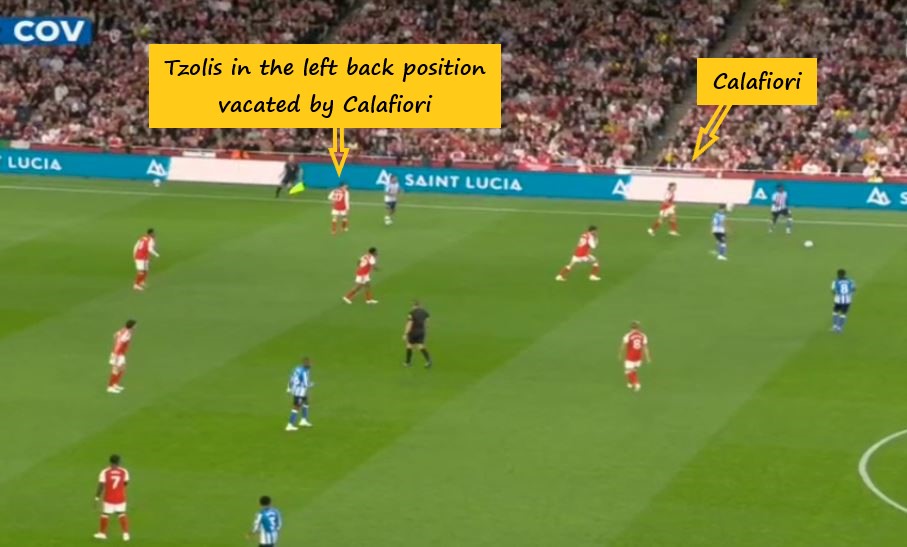
Tzolis appeared acutely aware of that from the opening minutes.
Coventry seemed willing to attack down Arsenal’s left side, and from around the fifth minute Tzolis could repeatedly be seen dropping deeper to support Calafiori.
Arsenal manager Mikel Arteta seemed to take note this partnership when he said, “You see different dynamics today on the left too with Christos and Ricky, different combinations.”
In the picture below, Tzolis has fallen back into a defensive position and is facing the Coventry player directly. It almost looks as though he is saying: “If you want to come through this side, you are going to have to go through me.”
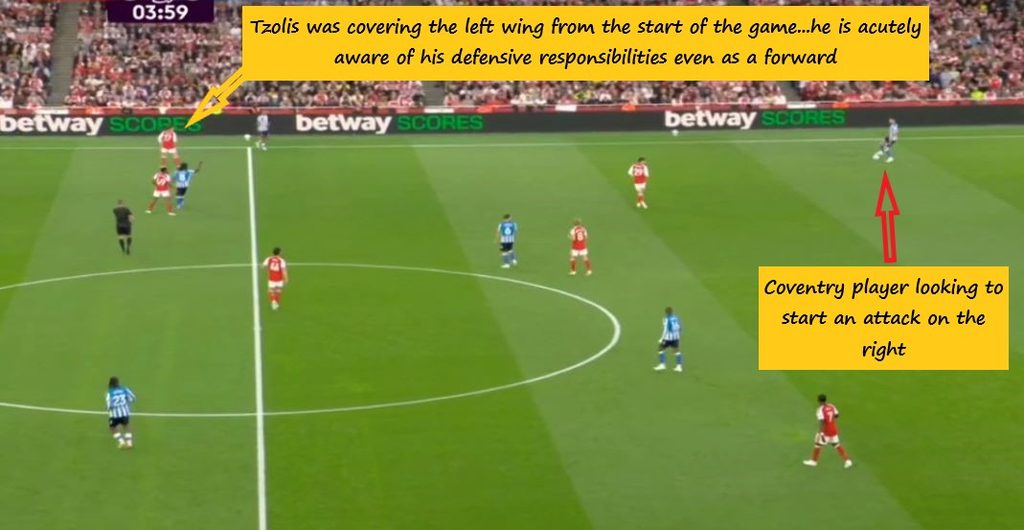
What makes the moment particularly interesting is the distance between Tzolis and Kai Havertz. While Havertz remains higher up the pitch to press, Tzolis has recognised that there is defensive work to be done behind him and has taken responsibility for it.
That awareness is important.
Attacking players can often be reluctant to retreat too far because they want to remain in positions where they can receive the ball and attack. Tzolis showed that he was prepared to sacrifice his attacking position when the team needed defensive cover.
And it was not only Calafiori that benefited from that defensive awareness.
In the 44th minute, Coventry again found an opportunity on Arsenal’s left. Calafiori had moved into the final third during an Arsenal attack, leaving Gabriel Magalhaes to cover the space behind him.
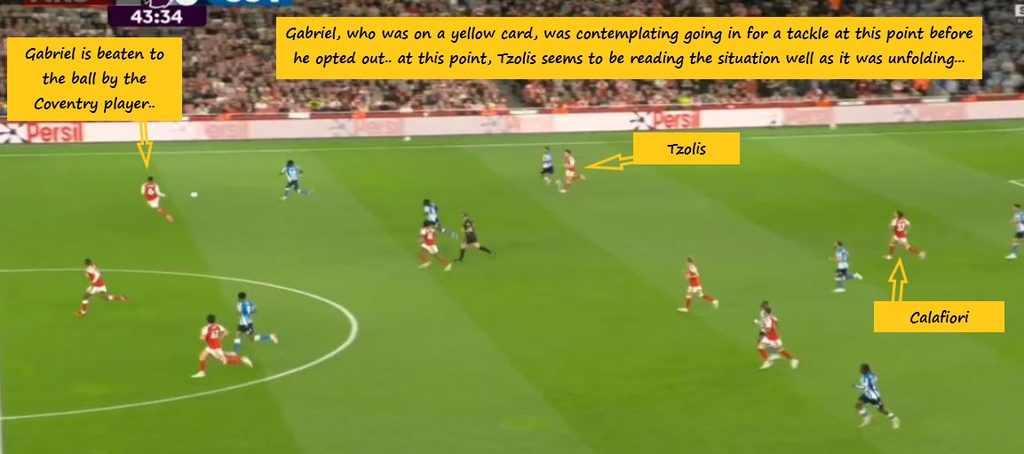
Gabriel appeared to be weighing up whether to challenge for the ball, but the situation was complicated by the fact that he was already on a yellow card.
Then Tzolis came back.
He moved across to support Gabriel and helped force the Coventry player to retreat and play the ball backwards.
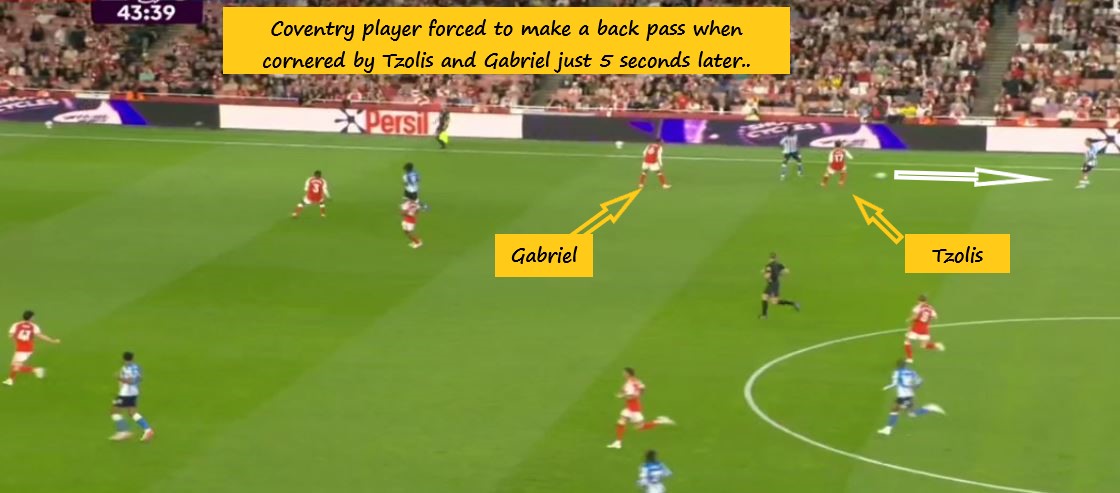
It was a small moment in the context of a 3-0 victory, but it demonstrated something important about the new Arsenal signing.
Tzolis was not treating his role as simply that of a winger. He was thinking about the team around him.
That kind of defensive responsibility could become particularly valuable when Arsenal’s full-backs are aggressively involved in attacks.
Tzolis can make darting runs into the penalty area
One of Tzolis’ most underrated qualities could be his ability to carry the ball forward over significant distances.
Look at the position from which he receives the ball from Martin Odegaard in the sequence below.
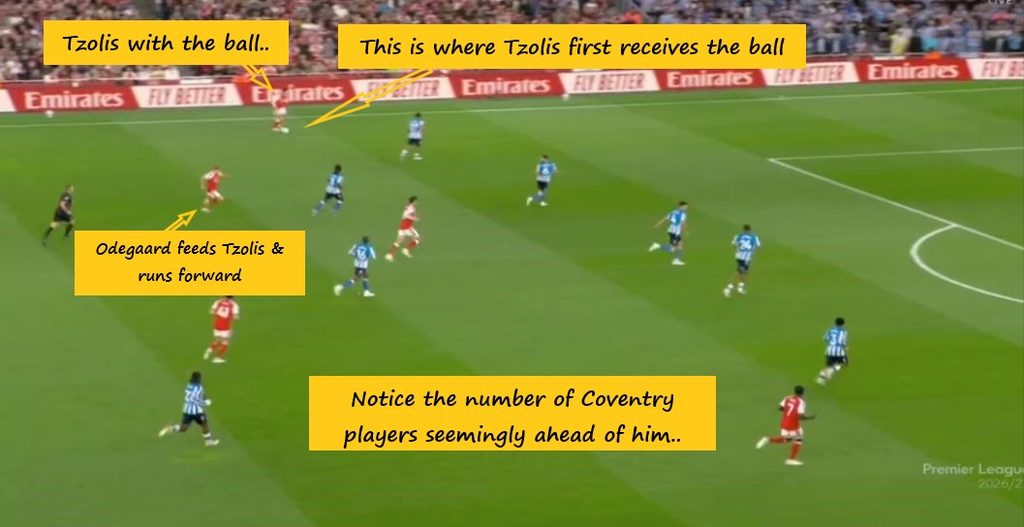
There are several Coventry players between Tzolis and the penalty area, yet he does not hesitate.
Within just a few seconds, he has carried the ball deep into the opposition’s 18-yard box and turned a situation that initially looked relatively difficult to achieve into a genuine attacking opportunity.
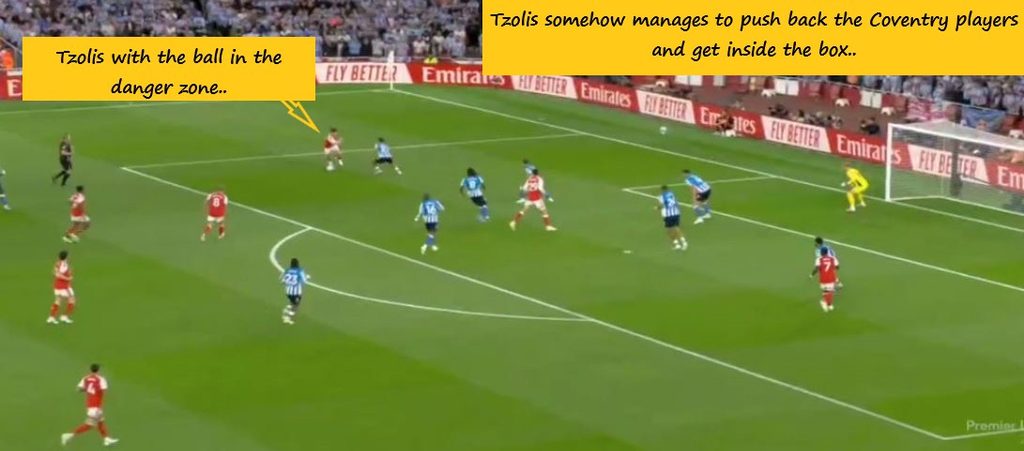
There is very little hesitation in his game once he sees an opportunity to attack space. The Christos Tzolis Arsenal debut offered an early glimpse of a player who could bring a different dimension to the left wing
He does something similar again in the 45th minute. On this occasion, he receives the ball much closer to the centre of the pitch than to Coventry’s goal line.
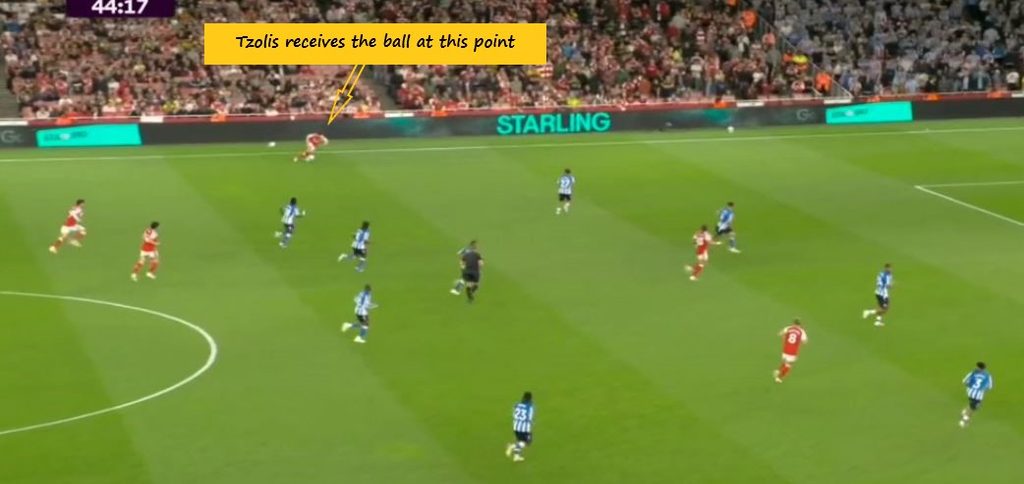
Yet again, rather than taking unnecessary touches or waiting for the attack to develop around him, Tzolis drives forward.
The next picture captures where he ends up only moments later, almost inside the penalty area and in a position where he is almost able to win a foul in a dangerous area.
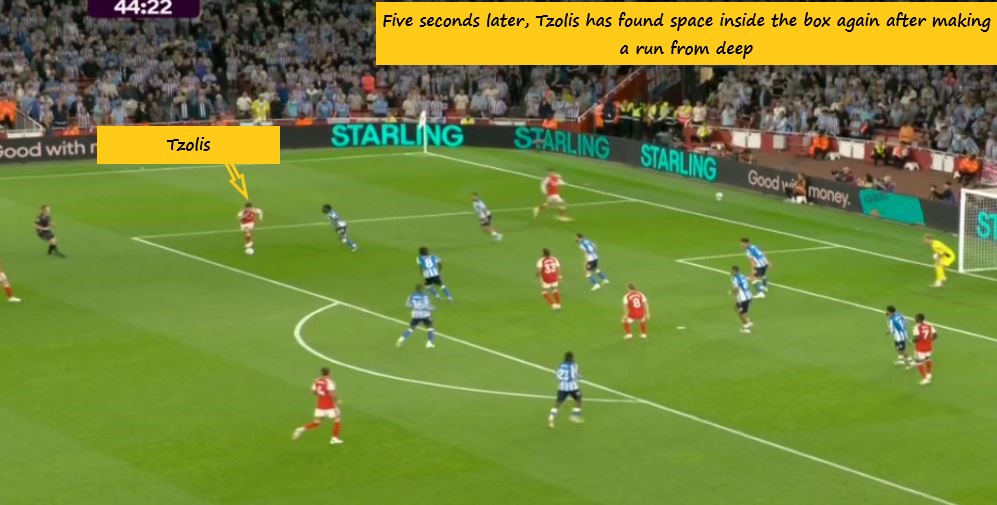
It is easy to see from these sequences why Tzolis can offer Arsenal something different.
He is not simply a player who wants to receive the ball wide and wait for an opportunity to cross. For a player making his Arsenal debut, the level of defensive commitment was encouraging
He wants to run at the defence.
He wants to attack the penalty area.
And when space opens up in front of him, he appears more than willing to exploit it.
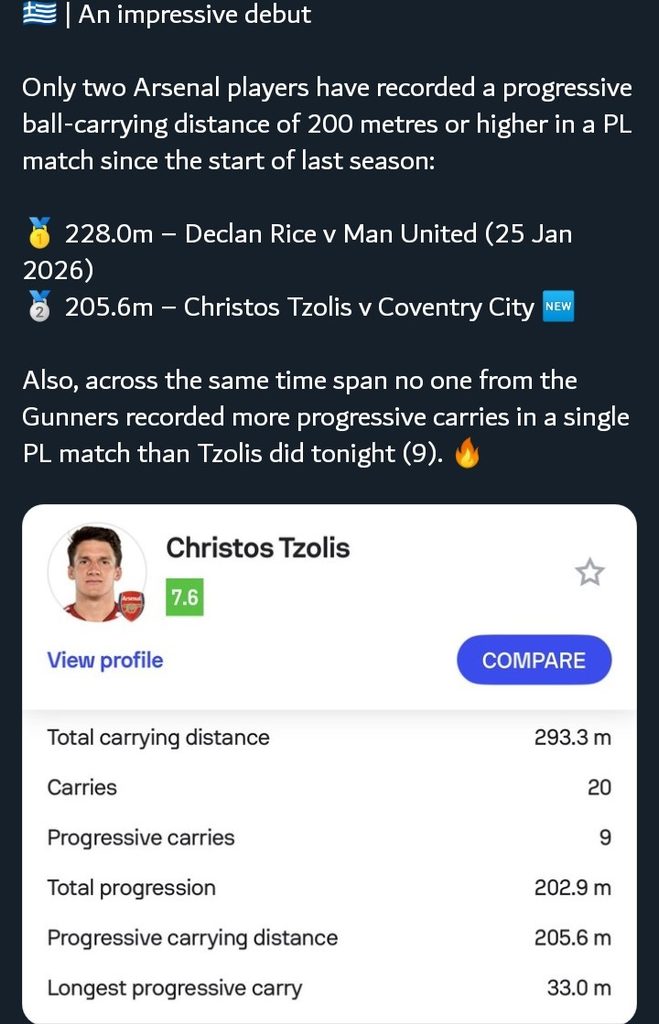
Tzolis seems to be one of the best ball-carrying players at Arsenal.
Tzolis showed positional dynamism
If you assumed Tzolis was simply a left winger who would remain on the left touchline for most of the game, his performance against Coventry offered a different picture.
He repeatedly moved away from his starting position to create different attacking possibilities for Arsenal.
Early in the game, Tzolis had been waiting for the ball on the left, but when the opportunity did not arrive, he moved across the pitch and helped create an overload on the right.
That movement was not random.
Tzolis timed his run behind the Coventry defender, once again showing that he was constantly looking for opportunities to attack the space behind the defensive line.
Declan Rice eventually found him with a through ball on the right, and Tzolis was able to deliver a dangerous cross into the penalty area and create another opportunity for Arsenal.
This is where his positional intelligence becomes important.
A winger who stays permanently in one position can become predictable. Tzolis’ willingness to move across the pitch gives Arsenal another way of disrupting an organised defence.
There was another example in the 72nd minute.
During an Arsenal counter-attack, Tzolis drifted towards the centre of the pitch and received the ball directly from David Raya.
Rather than immediately trying to drive towards goal, he turned and combined with Havertz through quick link play — touches, one-twos and give-and-go movements.
It was another indication that Tzolis does not appear restricted by the position written next to his name on the team sheet.
He can start on the left, move inside, appear on the opposite side and combine centrally when the situation demands it.
That positional dynamism gives Arsenal another layer of unpredictability.
Tzolis won the ball back to help create Arsenal’s first goal
It was definitely a great finish by Kai Havertz for Arsenal’s opening goal. It was an even better assist from Calafiori to help set up the goal.
However, none of it would have been possible if Tzolis had not won the ball back and immediately fed it to Calafiori, who then supplied Havertz to finish the move.
In the 35th minute, Arsenal fans at the Emirates applauded Tzolis, and nothing could have better exemplified the appreciation they were already beginning to show for the new signing.
Tzolis appeared to lose the ball following a heavy touch, but instead of accepting the mistake and allowing Coventry to take advantage, he reacted immediately.
He stretched to his limits, nicked the ball back and managed to feed it to Gabriel Magalhaes.
The reaction from the Emirates told its own story.
Arsenal supporters applauded the recovery, recognising the effort involved in correcting his own mistake before it could become a problem for the team.
That is the kind of moment that can tell you more about a player than a successful dribble.
Tzolis had made the mistake, but he did not switch off.
He immediately tried to repair it.
For a player making his Premier League debut for Arsenal, that level of commitment was encouraging.
Tzolis’ directness and eye for goal helped create Arsenal’s second goal
There is a difference between keeping possession and actually progressing an attack.
Tzolis stats against Coventry include 3 chances created, 2 shots on target, and 8 touches in the opposition’s box.
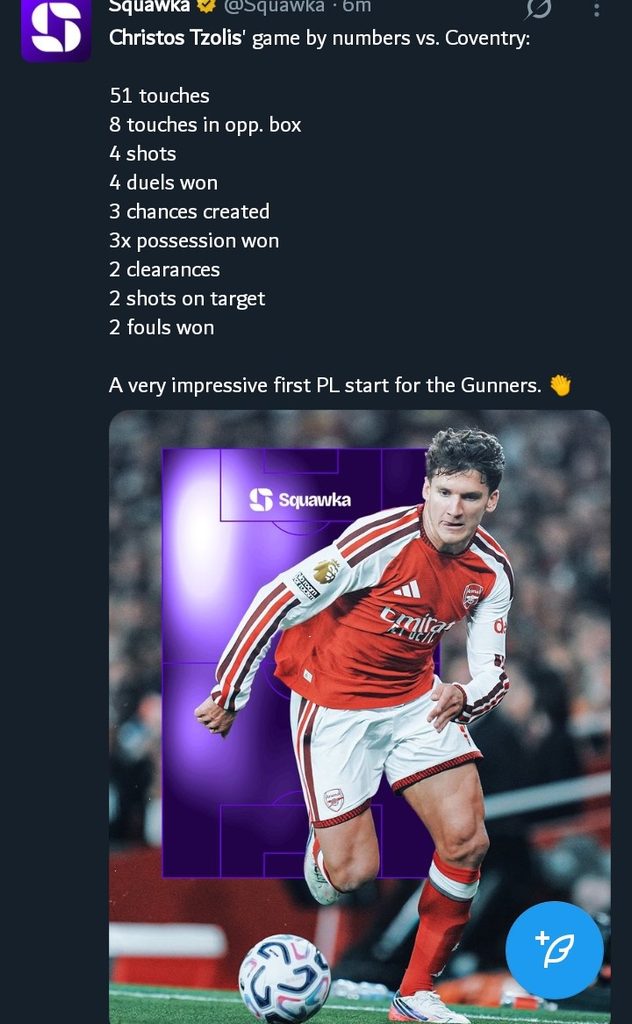
Players who take too many touches can sometimes allow a promising attacking move to disappear. The defender gets time to recover, the passing lane closes and the opportunity is gone.
Tzolis appears to have a different instinct.
His performance against Coventry showed a player who prefers to act quickly when the opportunity is there.
That was particularly evident in the move that produced Arsenal’s second goal.
On the surface, it may look like a relatively simple cross into the box, allowing Saka to pounce after the goalkeeper spilled the ball.
But that misses what made the moment impressive.
Tzolis was already positioned intelligently on the left, waiting for Rice to find him. Once the ball arrived, he did not delay.
He delivered the ball into the penalty area with his first touch.
There was no unnecessary attempt to cut inside.
No extra dribble.
No attempt to manufacture a more complicated solution.
He simply recognised what Arsenal needed and put the ball into the danger area.
That is what directness looks like.
Tzolis did not need to beat another defender before creating the opportunity. He did not need several touches to make something happen.
He saw the situation, received the ball and delivered it.
For an attacking player, that ability to make the right decision quickly can be extremely valuable.
And it was telling that by the 48th minute, Tzolis had created more goal-scoring chances than any other player on the pitch at that point.
His contribution was not based on one spectacular moment.
It was the product of repeatedly making positive decisions in attacking areas.
What did we learn about Christos Tzolis?
Tzolis’ first Premier League appearance for Arsenal was impressive not simply because he was involved in two goals.
It was impressive because of how he influenced the game.
He showed defensive awareness by covering for Calafiori.
He showed the willingness to recover possession after losing the ball.
He showed the pace and power to carry the ball into the opposition penalty area.
He showed positional intelligence by moving away from the left wing and appearing in different areas of the pitch.
And he showed directness by delivering the ball quickly when an opportunity presented itself.
Those qualities were evident throughout the match.
The performance also highlighted why Tzolis can potentially offer Arsenal something different from Leandro Trossard, the player he was meant to replace.
As the commentator pointed out during the game, Trossard had a knack for scoring important goals and producing decisive moments for Arsenal. But Tzolis brings a different physical profile.
He has greater pace when carrying the ball and appears particularly comfortable attacking space and driving into dangerous areas.
That difference could become significant over the course of the season.
It is, of course, far too early to draw major conclusions from one Premier League game.
But the early signs are extremely encouraging.
At 24, Tzolis looks like a player capable of giving Arsenal another dimension on the left wing.
His debut was lively, intelligent and direct.
For Arsenal fans wondering what Christos Tzolis could bring to the team, the answer from his Premier League debut was encouraging.
He is not just a left winger.
He looks like a player capable of making Arsenal’s entire attack more unpredictable. The biggest takeaway from Christos Tzolis’ Arsenal debut was not simply his involvement in two goals, but the variety of ways in which he influenced the game.
Leave a Reply